The Court Looks Away
The Court Looks Away
The Court Looks Away
The Supreme Court’s immigration rulings are not only about the border. They are about the legal imagination of power: who receives suspicion, who receives charity, and whose life can be turned back into a file.
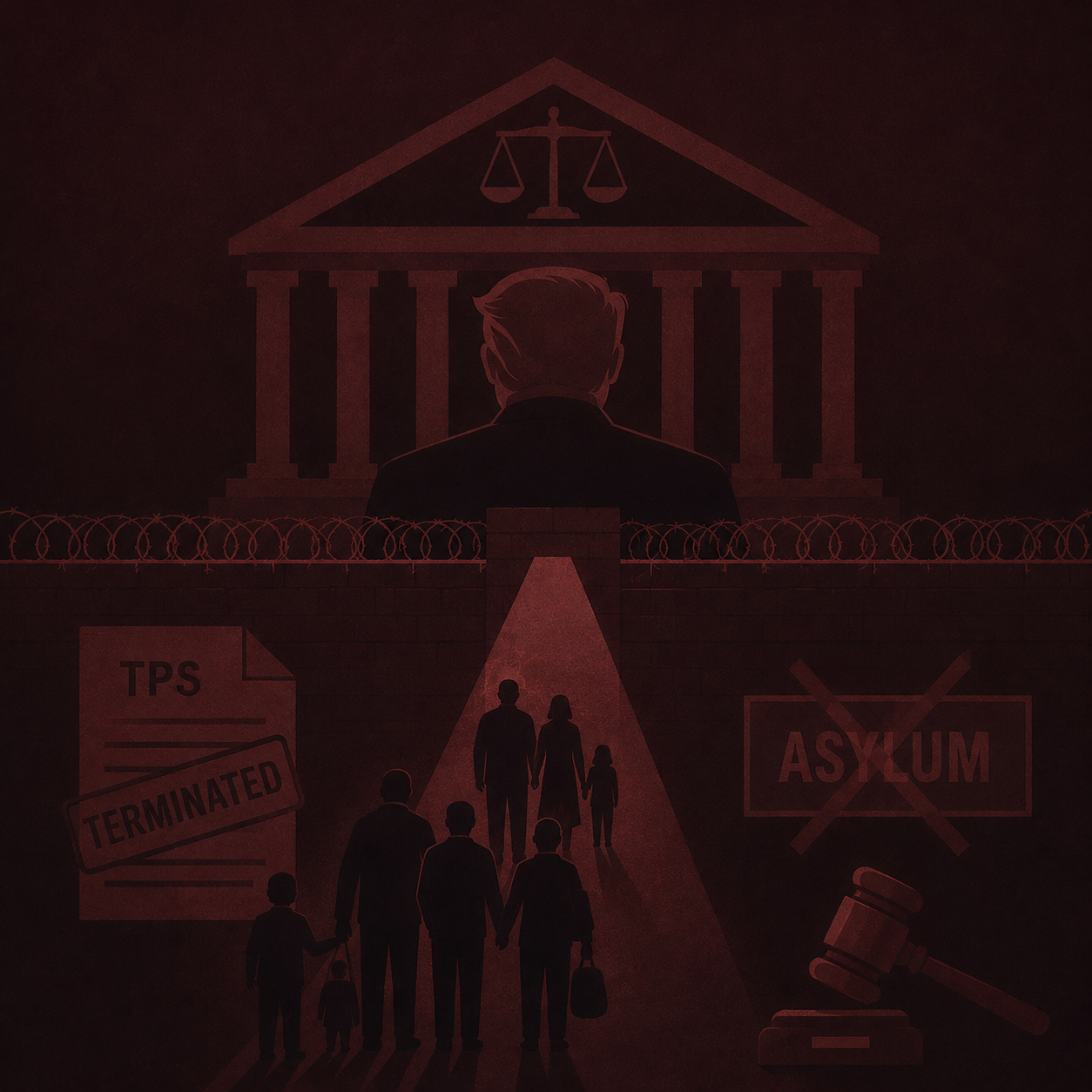
In one 6-to-3 decision, the Court allowed the Trump administration to end Temporary Protected Status for Haitians and Syrians who had been permitted to live and work legally in the United States for years.
The numbers matter because they remove the comfort of abstraction: about 350,000 Haitians and 6,100 Syrians placed closer to possible removal. In another 6-to-3 decision, the Court allowed the administration to prevent asylum seekers from crossing the U.S.-Mexico border to make their claims. Two cases, two opinions, the same direction of travel. The executive gains space. The people seeking protection lose ground.
The first case concerned Temporary Protected Status, a program created by Congress in 1990 for people whose home countries were considered unsafe because of war, natural disaster, or other crisis. The word temporary does a great deal of work here. It makes ordinary life sound provisional even after many years have passed. A person can work lawfully, rent an apartment, raise children, join a church, pay taxes, learn the routes of a city, and still remain suspended inside a category that can be withdrawn from above.
This is one of the quiet cruelties of immigration law. It allows life to become settled without allowing status to become secure. The person is present enough to work, present enough to contribute, present enough to build a life, but not present enough to belong. The state benefits from the labour and the orderliness of the arrangement. Then the designation changes, and what looked like stability is revealed as permission.
The Court’s majority treated the administration’s decision with remarkable generosity. The question was not only whether the executive had authority to end protection. It was also whether race had played a role in the decision to remove Haitians from protection. Under the leading precedent, if discrimination was a motivating factor, the decision would violate equal protection. Justice Elena Kagan, in dissent, said the record “fairly shout[ed]” that race entered into the president’s resolve to remove Haitians from the country. Justice Samuel Alito, writing for the majority, concluded otherwise. Trump’s statements about Haitians were not “overtly racial,” he said, and race was unlikely to have motivated the decision.
That phrase, “overtly racial,” carries the weight of the opinion. It tells us what kind of racism the Court is prepared to see. It must arrive plainly, almost ceremonially, in a form the majority finds legible. It must not be too coded, too contextual, too entangled with administrative language. A policy can fall with extraordinary force on a racialized group. It can follow years of degrading speech about that group. It can expose hundreds of thousands of Haitians to removal. And still the Court can say: not enough. Not overt enough. Not in the right shape.
This is how racial power is cleaned inside legal form. The state does not need to say that Haitians are being removed because they are Haitian. It can say that the designation has ended. It can say the Secretary has discretion. It can say the courts may not second-guess the judgment. It can say the president’s statements do not meet the threshold. The effect remains in the world. The motive is treated as fog.
The second ruling pushes the same logic to the physical border. If the state can stop an asylum seeker before entry, it can narrow the moment at which the legal claim becomes enforceable. The line is no longer only geographic. It becomes procedural. A person fleeing danger may have a right to ask for protection, but only after reaching the place where the request is recognized. The government controls that place. It controls the crossing. It controls the queue. It controls the delay. The right remains on paper, while the body is kept outside the frame.
This is why the immigration court system matters. Even the word court can mislead. Immigration courts are not Article III courts sitting inside the independent judicial branch. They are housed in the Executive Office for Immigration Review, inside the Department of Justice, under authority ultimately delegated by the Attorney General. The same branch that sets immigration policy, controls enforcement, and seeks removal also contains the administrative courts where many removals are contested.
That arrangement should trouble anyone who still uses the word justice with care. The migrant faces the state in a forum built inside the state’s own enforcement architecture. Federal courts remain as a possible site of review, but when the Supreme Court narrows that review, the circle tightens. The president gains discretion at the front end. Administrative adjudication remains inside the executive branch. Independent judicial review retreats at the back end.
The result is not the absence of law. It is law arranged around deference. Statutes remain. Procedures remain. Opinions remain. The vocabulary of legality remains intact. But the institutional weight moves in one direction. The state is read generously. The migrant is read strictly. The president’s motives are given room. The protected person’s reliance is given little. The asylum seeker’s fear must wait at the line. The executive’s judgment crosses it easily.
This is why these rulings feel ideological rather than merely technical. They choose where doubt goes. Doubt goes to Trump, whose statements are read charitably. Doubt does not go to the Haitian worker who has spent years building a lawful life under federal protection. Doubt does not go to the Syrian family who believed a designation meant something more than temporary mercy. Doubt does not go to the asylum seeker held outside the legal space where a claim can be heard.
A court does not need to shout its politics. It can reveal them by what it refuses to see. Here, it refuses to see racial power unless it arrives in the proper costume. It refuses to see settled life as a claim against sudden removal. It refuses to see the danger of placing so much immigration authority inside the executive branch and then calling that arrangement law.
The hard border is not only at the edge of the country. It runs through the legal system itself. Protection exists, but only while the state continues to recognize you. Justice exists, but only if a court is willing to look. In these cases, the Court looked at the president and saw discretion. It looked at the people in his power and saw procedure.