The Price SpaceX Declared

The Price SpaceX Declared
The Price SpaceX Declared
SpaceX fixed its IPO price before the roadshow. A month later, its shares have returned to almost the same number—and the market is only now beginning to discover what the company may be worth.
The most interesting number in the SpaceX IPO was not the $75 billion it raised or the $1.75 trillion valuation it received. It was $135.
That was the price of one share, but it was also an assertion. SpaceX published the number before its investor roadshow, reversing the usual sequence in which a company and its bankers first test demand and then establish a price. Some investors had sought a valuation of $1.5 trillion or less, but SpaceX arrived with its own answer and told its banks that it did not intend to move.
The company could do this because Elon Musk held unusual power over the offering. Banks wanted the fees and prestige attached to the largest initial public offering in history, and investors wanted access to a company they had watched from outside the public markets for more than two decades. Demand exceeded $250 billion. The price did not need to persuade the market in the ordinary way because the desire to participate had already done much of the work.
SpaceX had generated revenue of $18.67 billion in 2025 and recorded a net loss of $4.94 billion. A loss does not establish that a company lacks value, particularly when it is building expensive infrastructure and pursuing large future markets. But a valuation of $1.75 trillion required investors to pay for achievements that had not yet appeared in the accounts. They were buying future dominance in launch systems, satellite communications and artificial intelligence, and they were also buying Musk’s reputation for turning ambition into capital.
The shares closed their first trading day at $160.95 and reached a closing peak of $201.80 on 16 June. At one point during that session, buyers paid $225.64. The offer price appeared conservative within days of being declared.
It did not remain so.
By 14 July, SpaceX had fallen to $136.08, only 0.8 per cent above the original price. The market had added almost 50 per cent to the IPO price at the closing peak and then removed nearly all of it within a month.
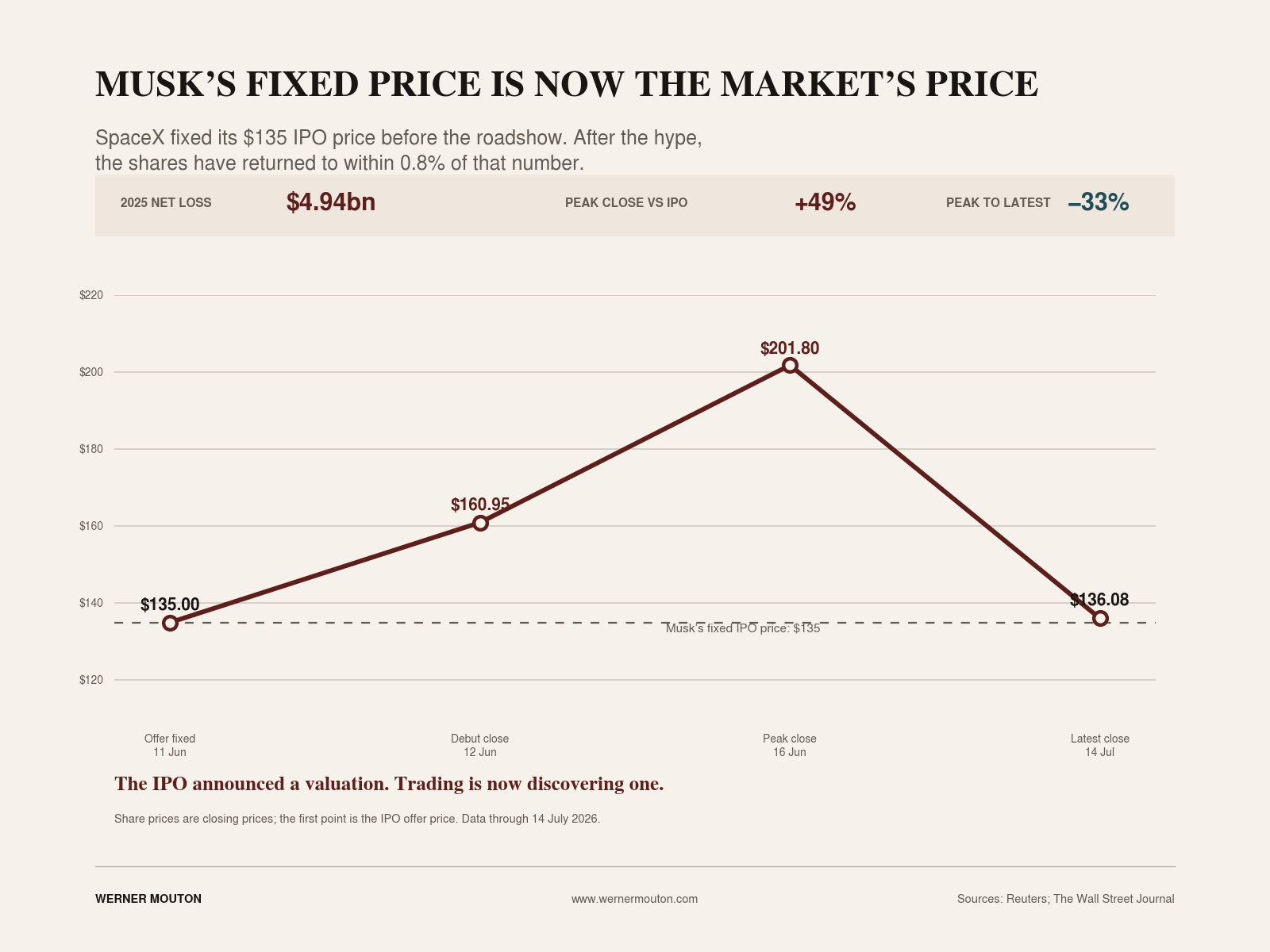
By 14 July, SpaceX had fallen to $136.08
This return to $135 does not prove that the original valuation was correct. The IPO price is not a neutral point to which the market naturally returns. It became an institutional boundary around which banks, funds and individual investors organised their behaviour.
Retail investors received 20 per cent of the offering, an unusually large allocation. Some brokerage platforms required these buyers to hold their shares for between 15 and 30 days or risk exclusion from future IPOs. Large funds faced fewer restrictions and could sell into the early demand. Underwriters also possessed an option that allowed them to buy additional shares and support the price, while early index inclusion created demand from funds whose rules required them to own the stock.
The market surrounding SpaceX was therefore never simply a crowd of independent buyers discovering value. It was constructed through allocations, holding rules, underwriting arrangements, index decisions and the power of the company controlling access to its shares.
That structure helped produce the first surge. It also made $135 important long before the wider market had tested it.
The present decline should not be treated as a final judgment on SpaceX. One month of trading cannot settle the value of a company whose largest claims concern businesses that may take years to develop. Markets also move for reasons beyond the company itself, and concern about expensive technology shares has weighed on prices more broadly.
But the path of the shares reveals a distinction that the excitement of the IPO briefly concealed. A company can announce a price, and banks can organise an offering around it, but neither action establishes value. Value must survive once shares begin circulating among people who do not need to preserve the success of the listing.
SpaceX entered the public market with the price already settled. The market is arriving late.
About Markets
Markets publishes independent, research-led analysis of global macroeconomics, central banks and consequential movements in global markets.
Selected articles are free. Most analysis is reserved for members, who receive complete access through Patreon.