World Movements: Issue 1
World Movements: Issue 1
Opening note
A decision not to attack can lower the price of oil within minutes. It cannot settle who controls the water through which that oil must pass.
The United States held back from another strike on Iran, but Iran denied that the talks used to justify the pause were taking place. Ships still moved through the Strait of Hormuz under threat. Elsewhere, China strengthened legal control over domestic chip designs. A European naval force boarded a sanctioned tanker. Denmark sent a new generation of conscripts into eleven months of military service. At Ceuta, thousands of people crossed from Morocco into Spanish territory, and Europe again depended on the country beyond its border to restore control.
These events happened in different places and at different speeds. Taken together, they show states trying to turn claims into practical power: control over a route, a design, a ship, a territory and the movement of people.
The ranking
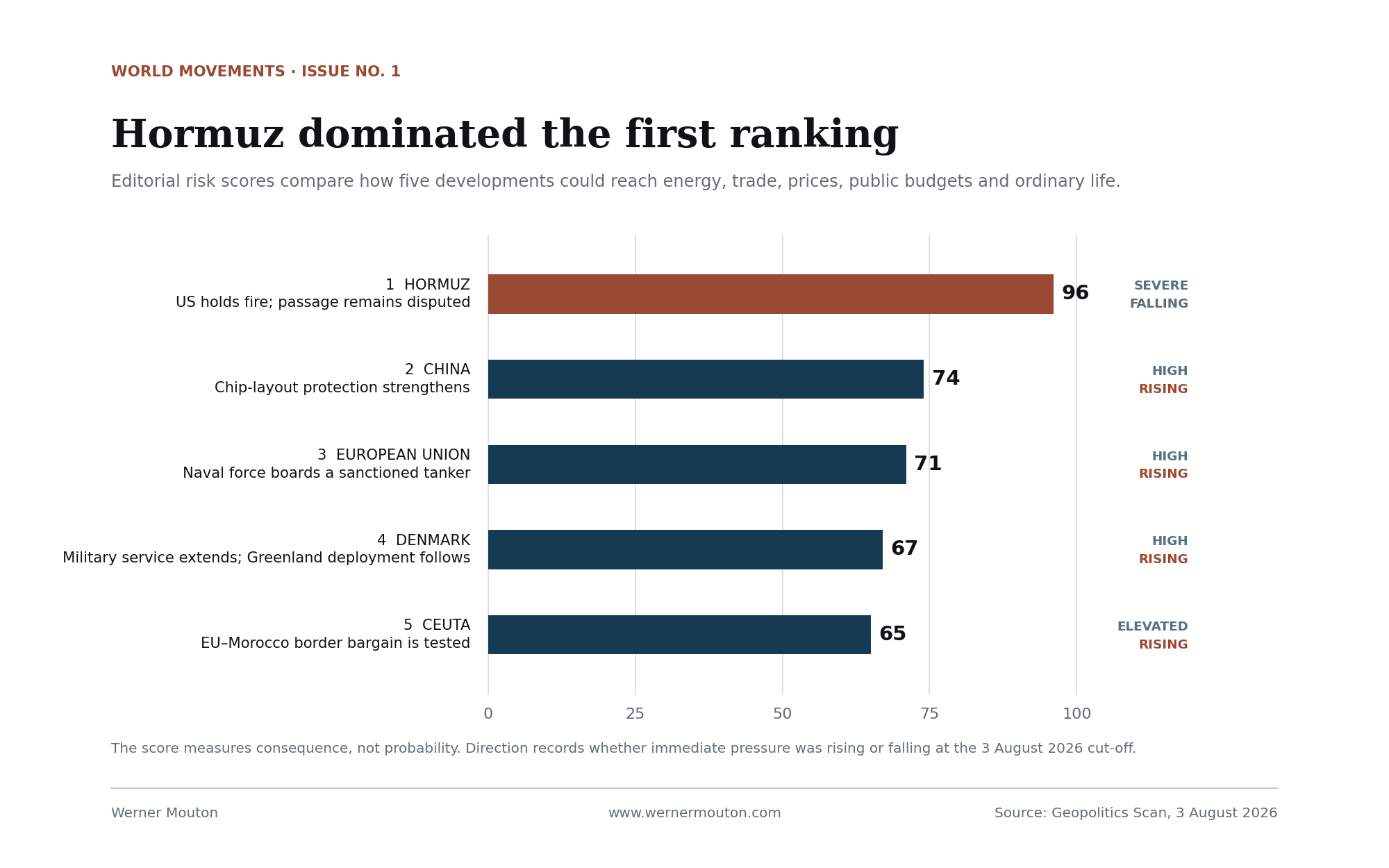
The ranking: Issue 1
Power needs a body
Governments produce documents. They publish laws, sanctions lists, defence agreements and migration pacts. These documents describe the world they want. They can assign rights, prohibit trade, define borders and tell institutions what to do. But a document cannot board a ship, defend a territory or stop a person at a border.
The distance between a rule and its practical force runs through all five movements in this issue.
This does not mean that laws and agreements are merely words. They organize power. A sanctions list can make a bank refuse a payment before any police officer arrives. An export restriction can persuade a company to cancel a sale. A defence agreement can alter military planning without a shot being fired. Much of modern power works through anticipation: people comply because they believe an institution could enforce its decision.
Yet that belief must rest on something. Behind the document there must be a court, a customs officer, a naval crew, a border guard, an engineer, a company or a citizen prepared—or compelled—to act. Somewhere, a person must carry the rule into the physical world.
The United States can declare that shipping through the Strait of Hormuz must remain open. Iran occupies the northern shore and retains the ability to interfere with vessels moving through it. Around 20 million barrels of oil passed through the strait each day in 2024. Saudi Arabia and the United Arab Emirates had only about 2.6 million barrels a day of unused pipeline capacity that could bypass it. Geography gives Iran leverage that American military power has not removed.
This is why the cancellation of an attack lowered oil prices but did not settle the dispute. Traders responded to a smaller immediate danger. Shipowners, crews, insurers and Asian refiners still had to contend with the route itself. A military pause is not an agreement about passage. Nor does American superiority across the wider region erase the narrow geography of the strait. A smaller power can possess considerable leverage when it stands beside something that larger powers cannot easily replace.
The people who decide whether the route remains usable are not only presidents and generals. Shipping executives must decide whether to send vessels through. Insurers must decide what risk they will cover and at what price. Captains and crews must make the passage. Refiners must find other supplies if the ships stop. Political conflict reaches the world through these ordinary commercial decisions, and then through the price of fuel, transport, food and manufactured goods.
China’s new rules for integrated-circuit layouts operate in a less visible space. They protect the arrangement of components and connections inside a chip. This sounds technical, but it concerns ownership of the knowledge that makes production possible.
The United States has used export controls to restrict China’s access to advanced chipmaking equipment and design software. China is responding by building a stronger legal perimeter around work produced at home. The factory matters, but so does the right to decide who may copy, license or use a design. Technology rivalry is therefore moving into patent offices, courtrooms and company contracts.
Here, the body behind power may be a judge, a patent examiner, an engineer or a company lawyer. The Chinese state does not need to seize every design physically. It needs institutions that can establish ownership, settle disputes and make companies treat those decisions as binding. The effectiveness of the rules will depend not only on their wording but on whether Chinese firms trust them, whether courts apply them consistently and whether foreign businesses believe that violations will carry a real cost.
Europe faces a related problem at sea. It has placed more than 670 vessels on sanctions lists connected to Russia’s shadow fleet. Those ships can change names, flags, owners and managers. Their legal identities move between jurisdictions while the tankers themselves continue carrying oil. A list can make trade more difficult, but it does not physically stop a vessel.
On 2 August, personnel from the EU naval mission Irini boarded the Toa Payoh west of Pantelleria. They inspected its papers but could not seize it. The ship continued its journey.
The boarding still mattered. Europe moved from identifying a vessel on paper to physically testing its identity at sea. Yet the encounter also exposed the limits of European authority. Inspection is not detention. Suspicion is not sufficient legal authority to seize a ship. A sanction is only as strong as the institutions willing and legally able to enforce it.
That limit is not necessarily a failure. Legal restraint distinguishes enforcement from arbitrary force. But restraint creates an opening that experienced operators can use. A tanker may sit inside a chain of shell companies, uncertain ownership and permissive registries. Europe must then establish not only what it suspects but what it can prove, where it has jurisdiction and what its personnel may lawfully do. Russia’s shadow fleet operates inside the gap between political intention and legal authority.
Denmark has taken a more direct route. About 1,600 recruits began eleven months of military service on 3 August, replacing the former four-month period. Later in the month, more than one hundred conscripts were due to serve in Greenland.
A defence agreement becomes real when someone leaves work or study, puts on a uniform and goes north. Denmark is converting the time of its young people into military capacity. It is also giving physical form to its claim that Greenland will be staffed and defended within the Danish realm.
The cost does not remain inside a defence budget. Conscripts and their families bear it through delayed earnings, interrupted plans and greater exposure to military risk. The state records expenditure in money, but defence also consumes months of human life. Whether citizens consider that burden legitimate will affect how durable the policy becomes.
This is one of the oldest forms of political power: the state’s claim on the body of the citizen. Modern military systems may rely on satellites, software and autonomous machines, but territory still requires people who can occupy, patrol and defend it. Denmark’s decision acknowledges that technology cannot completely replace physical presence, especially across the distances and climate of the Arctic.
At Ceuta, Europe encountered the same dependence in another form. Its new Migration and Asylum Pact had entered into application less than two months earlier. Yet when tens of thousands of people crossed from Morocco, Spain still depended on Moroccan police to slow departures and accept returns.
The fence is European. Control of movement begins on the Moroccan side.
Morocco therefore holds leverage that does not appear on a conventional map of economic or military power. It can tighten the border, relax it or seek concessions in exchange for enforcing it. Europe can offer money, equipment, trade access and diplomatic recognition. Neither side needs to state the arrangement openly for the dependence to shape their conduct.
The people trying to cross stand inside that negotiation. They are not simply a “migration flow,” as official language often describes them. They are people moving on foot, climbing fences, entering the sea, waiting in detention centres and facing return. Their bodies become the place where diplomatic pressure is applied and where the consequences of failed cooperation are felt.
These five movements do not represent the same kind of power. Iran’s leverage comes partly from geography and military capacity. China is building legal control over technical knowledge. Europe is testing the reach of sanctions. Denmark is drawing citizens into territorial defence. Morocco occupies the far side of a border Europe cannot control alone.
What connects them is the problem of conversion: how a government turns a claim into an outcome.
Power does not always belong to the largest state. It can belong to the actor positioned where a system can be opened, closed, delayed or made more expensive. It may rest with the country beside a strait, the institution that recognizes ownership, the crew permitted to board a vessel or the neighbouring government whose police stand beyond a border.
Documents matter because they coordinate these actions and give them authority. But the document is not the final act. Power becomes real when institutions can carry it into the world, when others believe they will do so and when someone is made to bear the consequences.
The five movements
Hormuz: Washington cancelled an immediate strike, but the route through which roughly one-fifth of global oil and liquefied natural gas trade once passed remained disputed.
Chinese technology: Beijing revised its protection for integrated-circuit layouts, giving domestic designers stronger rights over strategic knowledge produced inside China.
Europe’s shadow-fleet sanctions: An EU naval mission boarded a sanctioned tanker and inspected its documents, but the vessel was not detained.
Danish conscription: Denmark extended standard military service from four to eleven months and prepared its first operational deployment of conscripts to Greenland.
Ceuta: A mass crossing overwhelmed the Spanish enclave and showed that European border control still depends on cooperation from Morocco.
One question to carry forward
What happens when governments possess laws, sanctions and territorial claims, but depend on other states, private firms and ordinary people to make them real?