Argentina Paid the Bill but Still Needs the Dollars
Argentina Paid the Bill but Still Needs the Dollars
Argentina Paid the Bill but Still Needs the Dollars
The government met a large bond payment without issuing new debt abroad, but its wider plan still relies on loans, local bonds and state-asset sales.
On 9 July, Argentina paid $4.3 billion in principal and interest to holders of its foreign-law dollar bonds. The payment cleared most of what remained from roughly $19 billion in debt that Economy Minister Luis Caputo had to manage in 2026. Another $25 billion falls due in 2027.
Argentina’s borrowing premium collapsed
The payment was real. Bondholders received their money and Argentina avoided default. But it does not prove that the country has solved its debt problem. It shows that the government found enough dollars to meet this deadline.
Caputo says Argentina can cover its payments through October 2027 without issuing new sovereign bonds under foreign law. His plan draws on loans from global bodies and private banks, dollar bonds issued under Argentine law and money raised through the sale of state assets.
Argentina is therefore not shunning all markets or refusing all foreign finance. It is avoiding one form of borrowing: new bonds sold under foreign law to investors on world markets. The government still borrows from other lenders, and it still raises money through local markets.
The difference matters. A loan from a global body, a bank repo or a new local bond gives Argentina cash now, but the state must repay that money later. These tools can replace one debt with another, though the interest rate, due date and legal rules may differ. An asset sale works in another way. It raises cash without creating new debt, but the state gives up property and any income that property may have earned in future.
The government has raised about $800 million through state-asset sales, including four hydroelectric dams. Argentina’s central bank also entered into repurchase agreements worth $6 billion with private banks, and the government extended their maturities to September 2028.
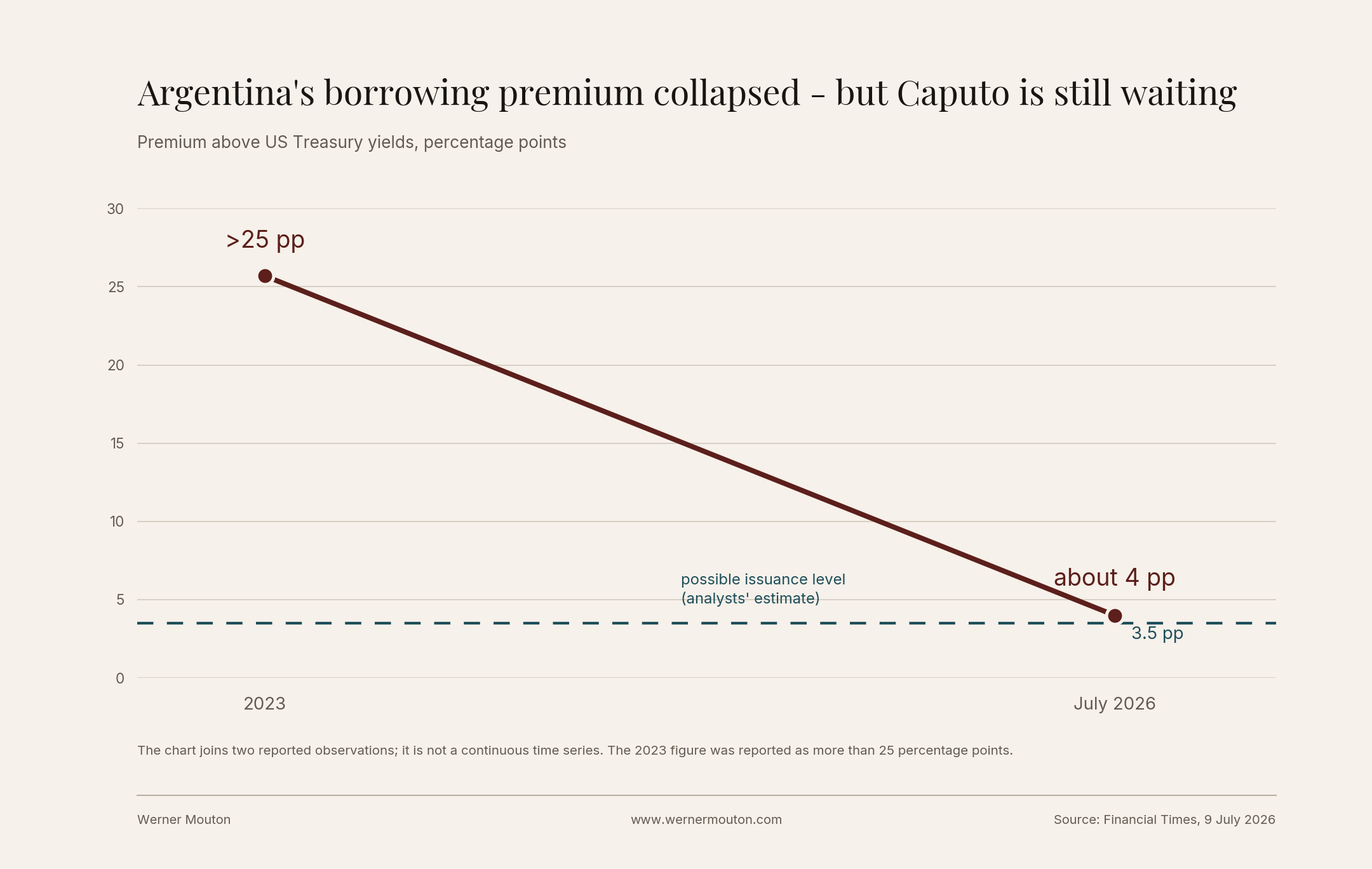
Caputo argues that these sources cost less than a new foreign-law bond. The interest premium investors demand on Argentine dollar debt has fallen from more than 25 percentage points above US Treasury rates in 2023 to about four points. Analysts believe Caputo may wait until that premium reaches roughly 3.5 points before issuing abroad.
Waiting may save money, but it also carries risk. Analysts found a $2 billion gap marked only as “other sources of financing” in the 2027 plan, along with $1.5 billion in expected privatisation proceeds that the government has not yet raised. Elections are due in October 2027, and past Argentine elections have brought pressure on the peso and higher borrowing costs.
The International Monetary Fund offers a mixed view. It expects Argentina’s economy to grow by about 3.5 per cent in 2026 and expects inflation to fall further. But it also says the country’s foreign-currency reserves remain thin and that Argentina’s ability to repay the Fund faces “exceptional risks.” The IMF expects Argentina to regain steady access to international capital markets over time.
Argentina has won time and avoided default, and those are real gains. But the July payment answered only the first question: could the government find the dollars for this bill?
The harder question remains: can it keep finding dollars for the next payments without taking on costly new debt, selling more state assets or returning to world markets when conditions are worse?
Sources
Financial Times, 9 July 2026, “Argentina repays $4bn as Javier Milei’s government shuns global markets.”
International Monetary Fund, Argentina: 2026 Article IV Consultation and Second Review, May 2026.