When Trust Becomes a Risk

When Trust Becomes a Risk
When Trust Becomes a Risk
The chart appears to measure European confidence in Donald Trump, but it reveals something larger than personal dislike. Countries can work with a president they dislike. They cannot organise defence, trade, finance and diplomacy around a government whose commitments may change without warning. Power depends not only on what a country can do, but on what others believe it will continue to do.
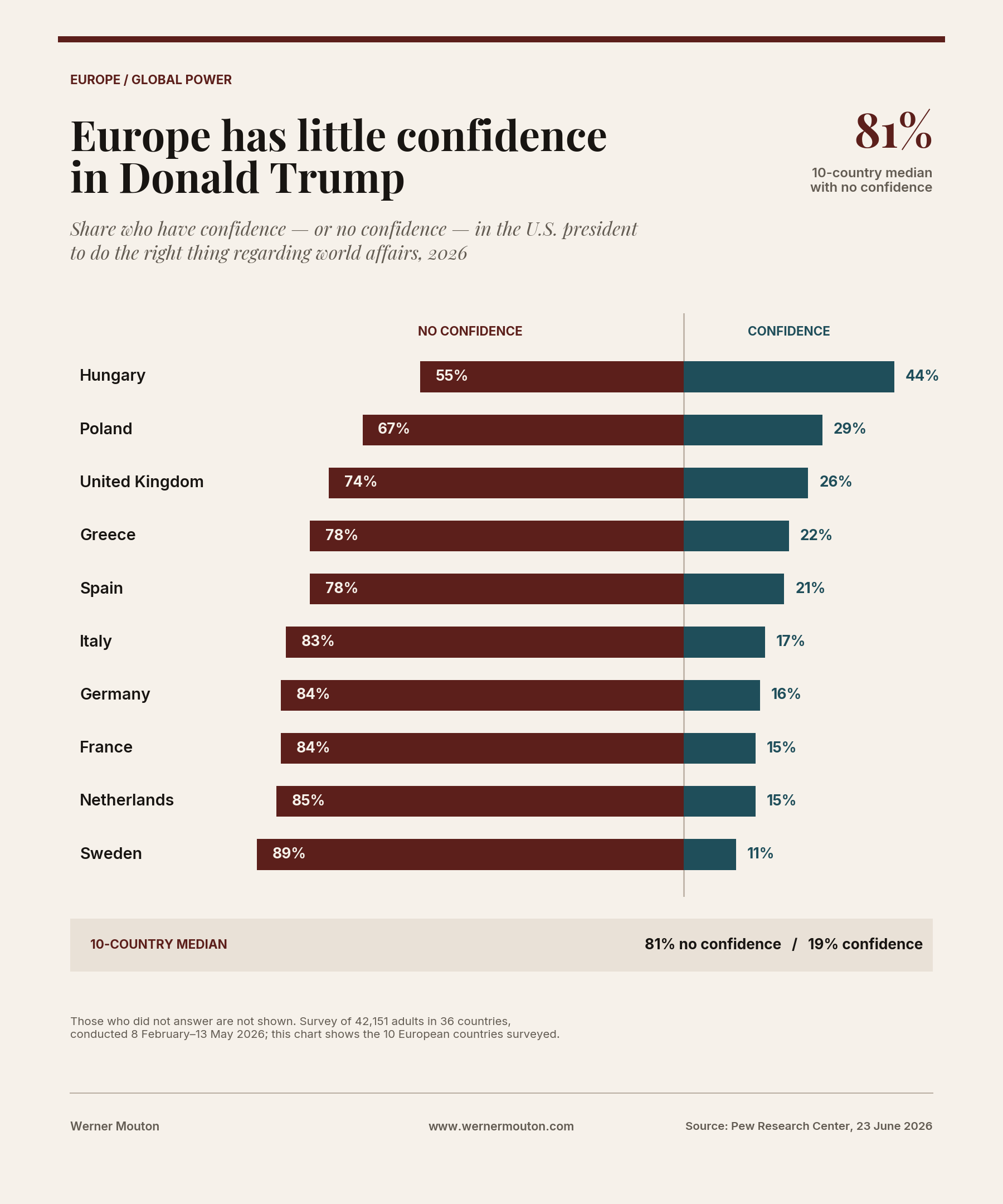
European confidence in Donald Trump
Pew Research Center surveyed 42,151 adults across 36 countries between February and May 2026. In the ten European countries included in the chart, a median of 81% said they had no confidence in Trump to do the right thing regarding world affairs. Hungary and Poland were the only two where majorities still considered the United States a reliable partner. In the other eight, confidence in American reliability had fallen by between 28 and 52 percentage points since the previous survey.
Yes, the world wants to move away from the United States. But moving away does not necessarily mean moving towards China, Russia or some new centre of power. Most governments do not want another master. They want options. They want supply chains that cannot be closed by one government, defence systems that cannot be withdrawn after one election, financial arrangements that cannot be turned into sanctions overnight and diplomatic relationships that survive a change of administration.
This is how power begins to disperse. It does not always happen through a dramatic break. It happens when dependence starts to feel dangerous and countries quietly build alternatives. Europe buys weapons from more suppliers. Governments negotiate trade agreements outside the American system. Central banks hold a wider range of assets. Companies move production, data and capital across several jurisdictions. Each decision may look technical, but together they reduce the influence that comes from being indispensable.
The United States built much of its postwar power through institutions, treaties and repeated commitments. Those arrangements were never innocent, and America often used them to advance its own interests, but they gave other countries some reason to believe that American power would operate within recognisable limits. Trump treats many of those commitments as transactions that can be reopened whenever he believes the United States deserves a better price. Allies then learn that an agreement is not a settlement. It is only a pause before the next demand.
The immediate cost falls on countries that must spend more to protect themselves from American uncertainty. The deeper cost falls on the United States. Influence exercised through trust is cheaper and more durable than influence exercised through threats. Once allies begin building systems that do not require American reliability, Washington cannot restore its old position through a speech, an election or another promise.
American military, financial and technological power remains immense. But power also lives in the decisions other countries make before a crisis arrives. The movement away from the United States will not begin with a declaration. It has already begun in the search for somewhere else to stand.