

A Grid Serves a Place
In 2024 data centres used about 1.5% of the world’s electricity, the International Energy Agency estimates. I posted the figure on X this week with the belief I brought to it: that AI would strain the world’s power supply. The number looked too small to prove it. A reader asked whether the IEA splits its forecast by grid region. It does not. It projects by country and bloc: the United States, China, Europe and Japan.
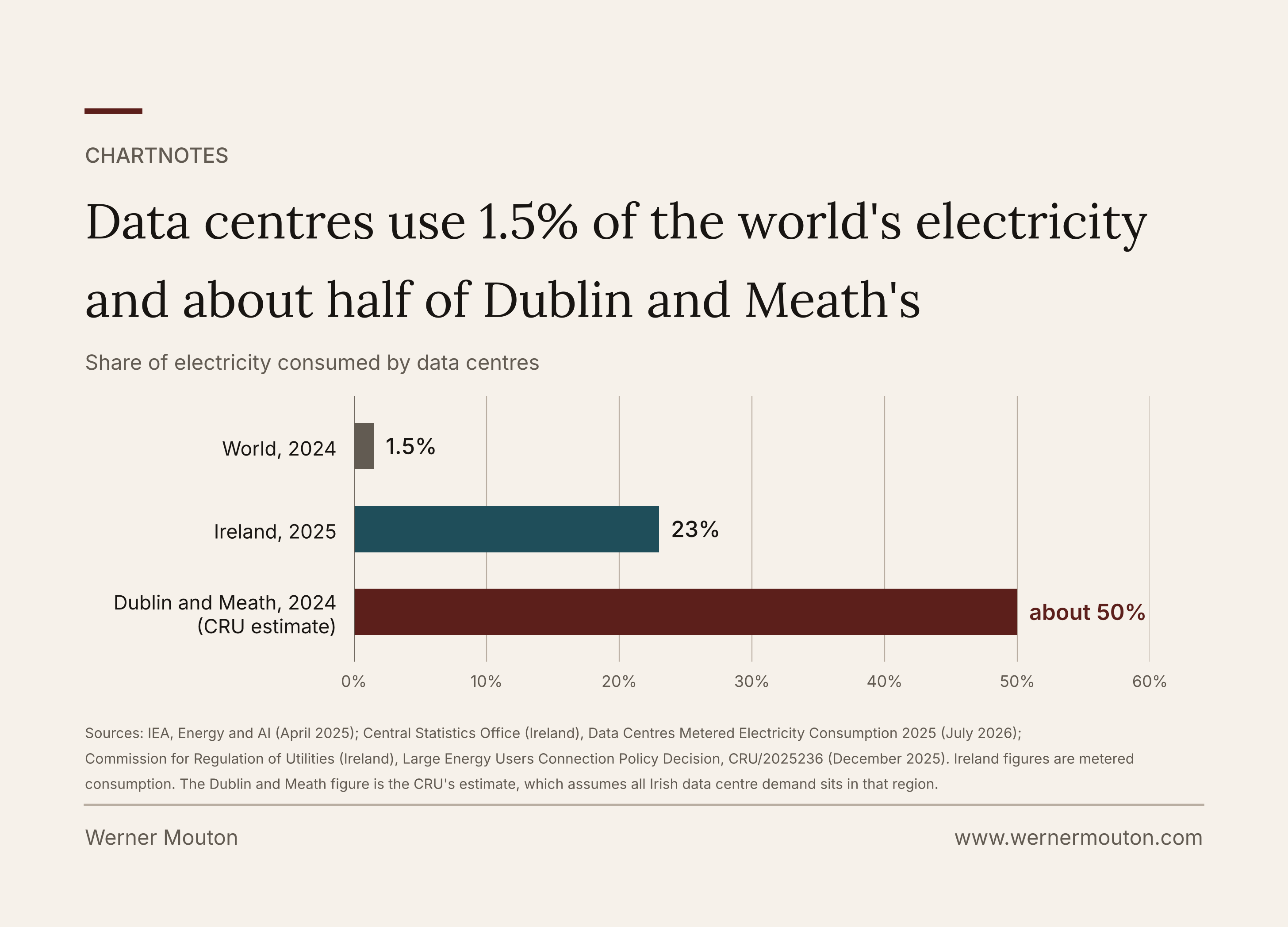
In 2025 data centres used 23% of Ireland’s metered electricity, the Central Statistics Office reports. In December 2025 Ireland’s energy regulator, the Commission for Regulation of Utilities, estimated that data centres used about half the metered electricity in Dublin and Meath in 2024.
The strongest objection is that Ireland is an outlier, and the regulator’s own paper supports it. Citing the market analysts ICIS, it reports that 97% of Ireland’s data centres sit in Dublin. In the same figures, the next highest share is Amsterdam’s, with 44% of the Netherlands’ data centres. The IEA expects data centres to account for around a tenth of the world’s growth in electricity demand to 2030, less than air conditioning or electric cars. My belief was about the world’s supply, and the world’s figures do not carry it. I concede that.
The cost does not stay in Dublin. A model commissioned by Friends of the Earth Ireland found that data centre demand made gas plants set Ireland’s wholesale electricity price more often. By its estimate, households across the country paid about €715 million more between 2015 and 2023, or €263 per household.
The regulator’s paper makes a different point about a different part of the bill. It says more demand spreads network charges over more units, which can lower the charge per unit. Both can be true at once. Nor are network charges set by place: respondents told the regulator that Ireland’s network tariffs give no explicit price signal by location, and the regulator recorded the point without disputing it.
The regulator’s answer to the shortage of grid capacity is a rule. A new data centre that asks for 10 MVA or more of grid capacity cannot reach that capacity until it has built generation or storage, on site or nearby, to match it. The operator chooses which. Batteries burn nothing. Gas engines burn gas, and the Environmental Protection Agency licenses them for their emissions to air and their noise. One gas plant already licensed to power a data centre, on Peamount Road in County Dublin, will account for 8.6% of the electricity sector’s emissions ceiling by 2030, by its operator’s own figure.
The rule moves the power station closer to the data centre. It does not move it away from anyone.