

Prices Rose 3.9% in 13 Months. The Fed Should Raise by Half a Point
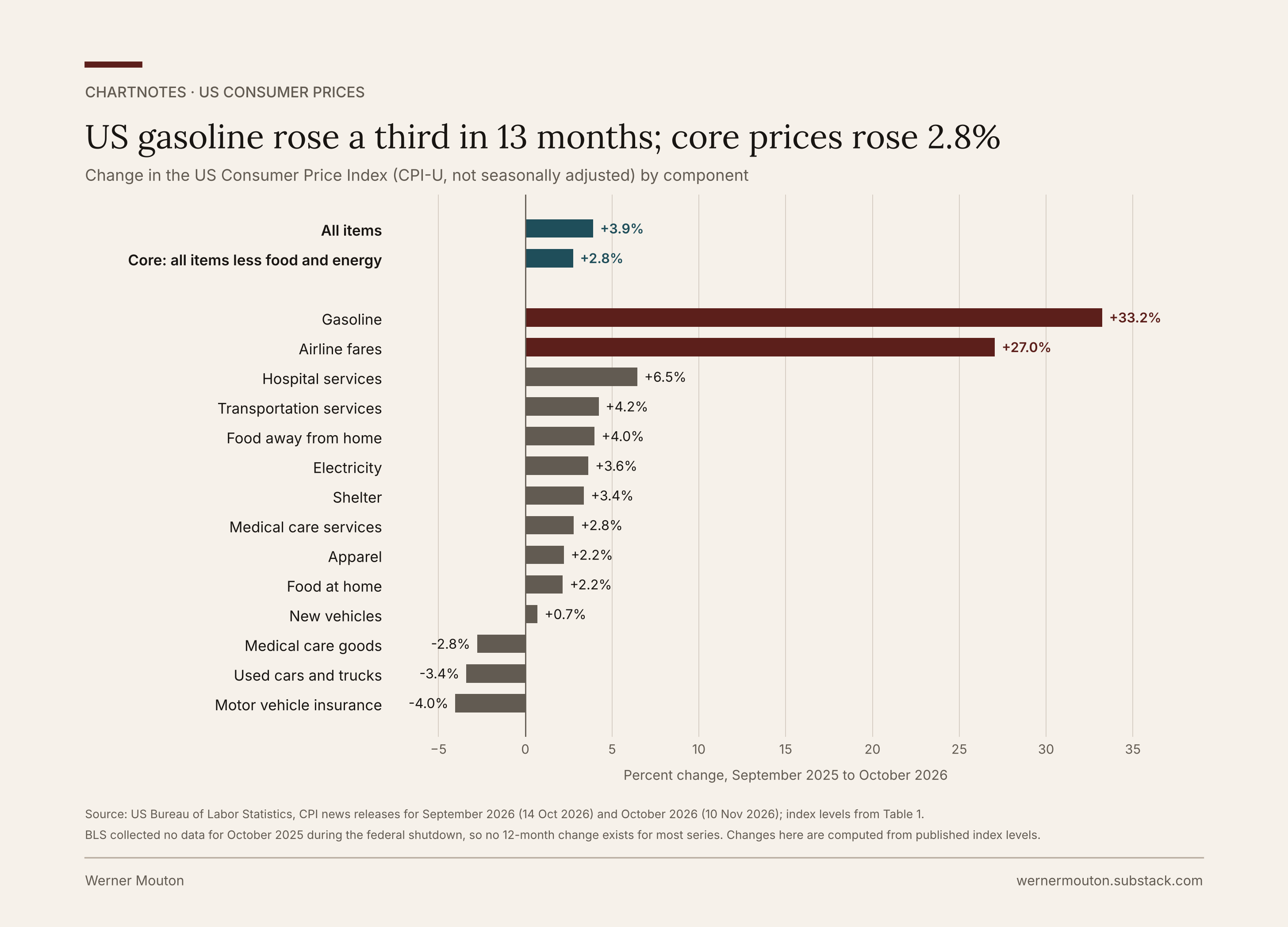
A year ago there was no CPI release. The US government shut down in October 2025, and the Bureau of Labor Statistics collected no prices that month. So it cannot publish a 12-month change for most of what Americans buy. I based my chart on the last month before the gap. It measures each price from September 2025 to October 2026, thirteen months, using the index levels BLS published on Tuesday.
Over those thirteen months, US consumer prices rose 3.9 percent. Core prices, without food and energy, rose 2.8 percent. Gasoline rose a third and airline fares 27 percent. Hospital services rose 6.5 percent, food away from home 4 percent and electricity 3.6 percent. Shelter, a third of the basket, rose 3.4 percent. Used cars and car insurance fell.
On the same day, the Treasury sold $42 billion of ten-year notes. Buyers demanded a yield of 5.02 percent, and the notes carry a 5 percent coupon. That rate is now fixed until 2036. The government will pay $2.1 billion a year on this one sale, $21 billion before the notes mature. And it must come back to the market every month and borrow at whatever rate buyers ask.
The Fed held its rate at 3.75 to 4 percent in October. Two members, Lisa Cook and Beth Hammack, voted for a quarter-point rise. The Fed meets again on December 9, and the debate now is how large the rise should be. Traders in fed funds futures give an 88.8 percent chance of a quarter point and 11.2 percent of a half point. I think the traders have the likely outcome right. A half point is hard to sell to people who already pay more for fuel, rent and loans, and to a government that pays 5 percent on its debt.
But the facts point to a half point. The Fed’s target is 2 percent on the PCE price index. That index came near it once, at 2.1 percent in September 2024, the lowest since February 2021. This September it stood at 3.6 percent, with core at 3.1 percent. For more than five years the Fed has promised a return to 2 percent and has not delivered it. A quarter point tells the market the Fed will move slowly again. The bond market has already answered that with a 5 percent coupon, and the government now carries that rate for ten years.