

Japan holds more US Treasuries than any other foreign country
But it held US$141.6 billion more in April.
Japan holds more US Treasuries than any other foreign country. At the end of August it held US$1,068.3 billion, by the US Treasury’s own count. The United Kingdom held US$1,009.5 billion and mainland China US$590.7 billion.
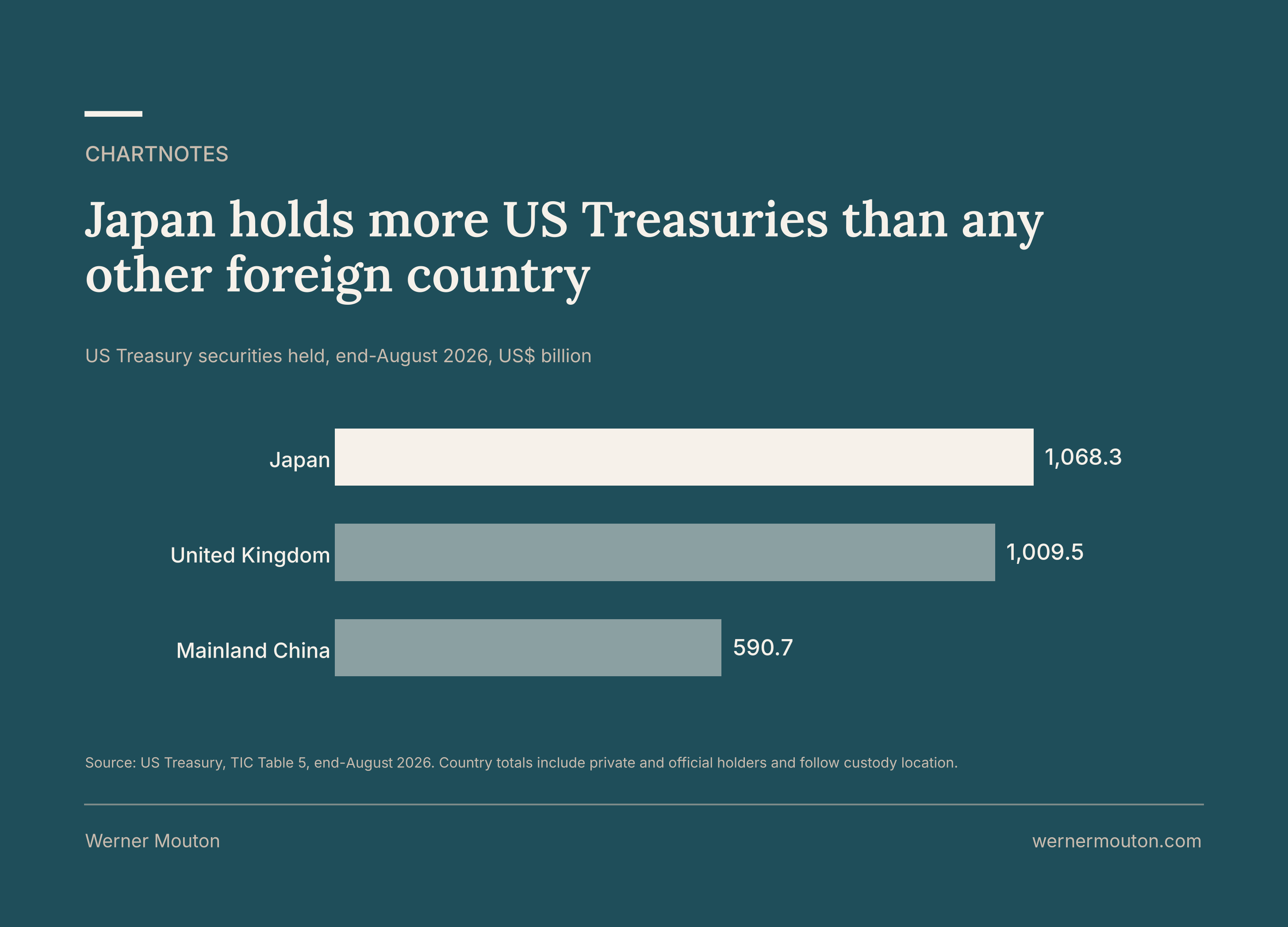
The chart shows the rank. It does not show the direction. In April Japan held US$1,209.9 billion. Four months later it held US$141.6 billion less. The United Kingdom added US$72 billion over the same months, and Japan’s lead over it shrank to US$58.8 billion.
The Treasury’s table counts every holder in a country together, the government with the insurers and the banks. So it does not say who in Japan let go. But Japan has two kinds of holder, and they sell for different reasons.
The first is the Ministry of Finance. It holds Treasuries as reserves, and it needs dollars when it buys yen. The yen fell to a 40-year low in July. Late that month Japan bought yen, and Scott Bessent’s Treasury bought alongside it.
The second is private: the life insurers, the pension funds and the banks. They hold Treasuries for the return, and the return has changed. The 10-year Japanese government bond passed 3% this year, the first time in three decades. It stood at 2.665% on 6 November. An insurer in Tokyo who buys a Treasury must also pay to hedge the dollar, and the hedge cuts the yield. TD Economics did the sum in March: about 2.3% on the Japanese bond against about 1.3% on a hedged US Treasury. The insurer earns more at home.
So far the insurers have sold little. Japan’s Ministry of Finance counts more than 5 trillion yen of net foreign bond sales by Japanese investors this year, about US$32 billion. The life insurers sold only 289 billion yen of that. But they have a great deal left to sell. The Life Insurance Association of Japan puts their assets at about US$2.5 trillion, with roughly a quarter held abroad.
The US government needs buyers. Its debt stands at about US$40 trillion. On 9 September Bessent’s Treasury said it would buy back up to US$6 billion of its own bonds. The next day the US 10-year yield reached 4.93%, the highest since 2023. Oil above US$100 a barrel and the size of the debt drove that rise, not Japan.
TD Economics estimates that weaker Japanese demand could add between 0.2 and 0.5 percentage points to the US 10-year yield.