

The Fed turns towards bigger rate rises while the US Treasury tries to hold long-term yields down; plus two systems that failed without an attack, and South Africa’s buyback done by the book.
This was the week the Federal Reserve ran out of patience, and the bond market got there before it did. The US Treasury is still trying to hold long-term borrowing costs down with one hand while it borrows record sums with the other. I do not think it can do both.
Waller stops waiting
On 28 October the Fed held its range at 3.75 to 4 per cent. Lisa Cook and Beth Hammack voted for a quarter-point rise; Christopher Waller voted with the majority. In London on 10 November Waller said he “was willing to wait” in October, and then that a half-point rise should be considered in December if core inflation stayed high, because “hiking only 25 basis points would put our credibility at risk”. Hours later the Bureau of Labor Statistics reported that consumer prices rose 0.4 per cent in October and core prices 0.3 per cent, the reading he had named. The bureau cannot publish a twelve-month rate for October, because it collected no prices a year earlier during the federal shutdown.
The market did not wait for the committee. By Friday the US two-year Treasury yield stood near 4.87 per cent, about a full percentage point above the midpoint of the Fed’s range, and the ten-year was above 5.1 per cent. Futures now price a December rise as certain. The Bank of England moved first: on 5 November it raised its rate to 4 per cent and said it expects British inflation of about 5 per cent by mid-2027, with energy prices from the Middle East conflict feeding into everything else.
The Treasury pulls the other way
Since August the US Treasury has bought back its own long-dated bonds in larger operations, first at least $4bn, then up to $6bn at a time, and it began outside its usual quarterly schedule. Scott Bessent told CNBC the level of yields did not factor into the decision. He has also called the programme a “Treasury twist”, after the Fed’s Operation Twist, whose purpose was to bring long-term rates down.
The precedent is not encouraging. In the early 1960s the Fed tried to hold long rates down while keeping short rates up, to defend the dollar. The Bank for International Settlements later found that for every dollar of long bonds the Fed bought, the Treasury sold many times as much. The same sum defeats the twist now. In October alone the federal deficit was $404bn, 42 per cent more than a year earlier, and a few billion dollars of buybacks a week cannot absorb that supply.
A fifth of every dollar
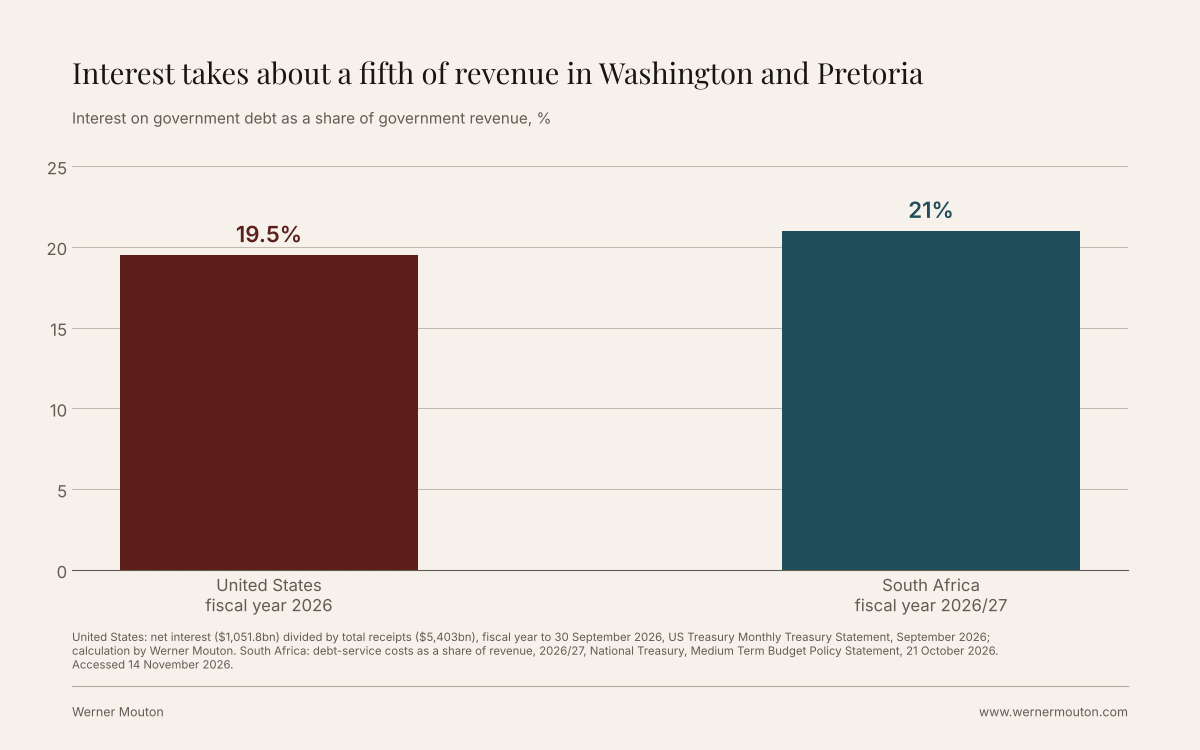
The reason for the Treasury’s activism is in its own accounts. Net interest cost the federal government more than $1tn in the year to September, about 19 cents of every dollar it collected. South Africa’s National Treasury says debt service now takes 21 cents of every rand. On this measure Washington sits beside an emerging market, and every rise in the Fed’s rate passes into that bill and into the price of every dollar loan, from a mining company in Johannesburg to a supermarket chain in Jakarta.
My call: on 9 December the Fed raises its range by a quarter point, to 4 to 4.25 per cent, and at least one member votes for half. If core PCE inflation for October, due on 25 November, comes in at 0.4 per cent or more, half becomes the likelier move and I am wrong.
No attack, and two systems stopped anyway
Microsoft’s email and office software failed on Thursday 12 November and stayed down for many users into Friday, in more than 70 countries. In Britain some NHS patients waited longer for prescriptions. Microsoft blamed a recent network capacity upgrade and said the failure was not an attack. On Friday afternoon the US Federal Aviation Administration held every departing flight in the country for about five hours. Sean Duffy, the transport secretary, said routers in an outdated air traffic control system had been overloaded with data, and he wants $30bn on top of the $12.5bn Congress approved last year. Markwayne Mullin, the homeland security secretary, said he saw no sign of an attack. On the evidence so far, neither failure needed an attacker. One system is a private service rented across borders, the other a public one its own minister calls outdated, and both failed from the inside on the same two days. When a faulty CrowdStrike update stopped Delta Air Lines in July 2024, Delta lost $380m of revenue and paid $170m in extra costs in one quarter. The fault was the supplier’s and the loss was the customer’s, and I expect the next failure to split the same way.
Pretoria buys back its bonds by the book
South Africa is buying back its own bonds too. Its medium-term budget of 21 October raised the gross borrowing requirement by R54.2bn to R434.2bn for 2026/27, largely to fund a buyback and switch programme that smooths heavy redemptions, with all operations “within established risk benchmarks”. Debt stabilised at 78.4 per cent of GDP in 2025/26, and the Treasury says rising global bond yields have pushed up emerging-market borrowing costs. Pretoria announced its buyback in a budget, sized and funded. Washington changed its plans between scheduled announcements. The Reserve Bank, which has raised its rate by half a point this year to 7.25 per cent, decides again on 19 November. Investors pay for predictability, and this time South Africa is the one supplying it.
One last chart
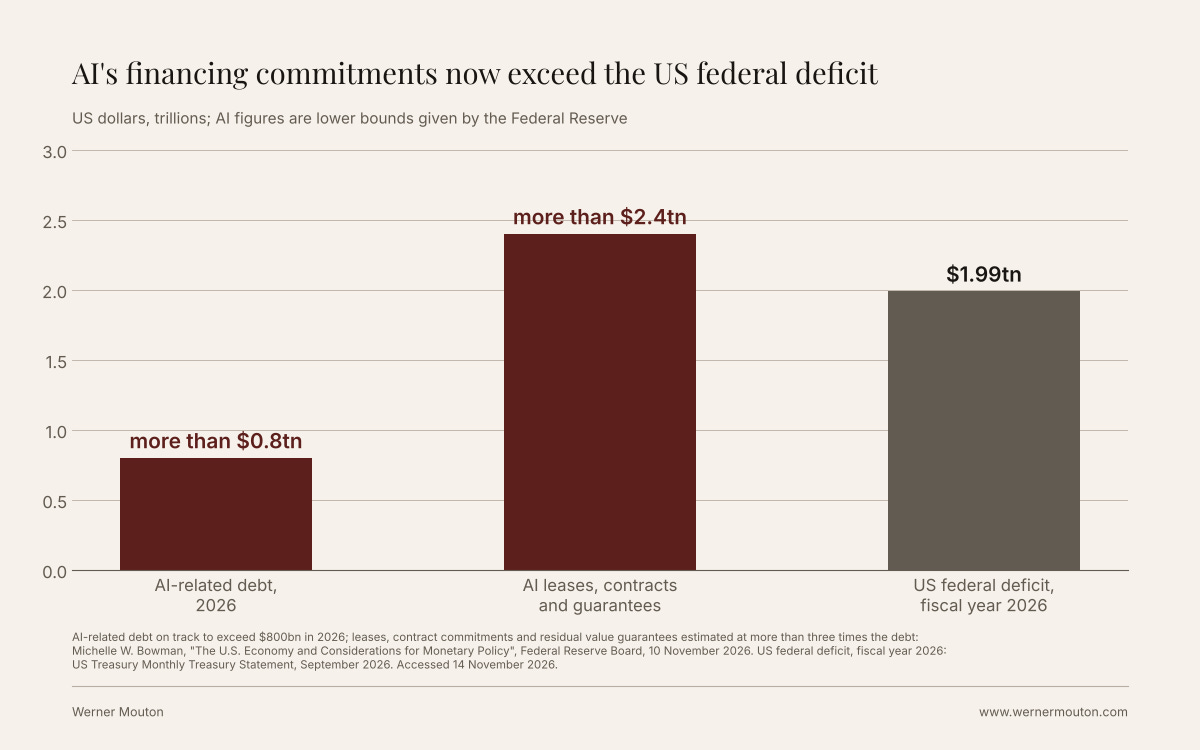
Michelle Bowman, the Fed’s vice chair for supervision, said this week that AI-related debt is on track to pass $800bn this year, and that leases, contract commitments and guarantees could add more than three times that. The commitments alone are larger than the US federal deficit of $1.99tn. She also put AI-related price pressure at about a quarter of above-target core inflation. AI is now both a borrower and an inflation source the Fed has to count.
What I’ve been reading
Christopher Waller, “The economic outlook”, Federal Reserve Board, 10 November 2026. The clearest account I have read of why a central banker changed his vote in a fortnight.
Michelle W. Bowman, “The U.S. Economy and Considerations for Monetary Policy”, Federal Reserve Board, 10 November 2026. The first Fed estimate I have seen of what AI adds to inflation and to credit.
National Treasury, Medium Term Budget Policy Statement 2026, chapter 3, 21 October 2026. How a finance ministry explains a bond buyback in public, with its sums.