

The Fed, its next rate rise and the debt behind the AI boom
The Federal Reserve’s minutes point to a rate rise in December and to the debt that pays for the AI build-out; Bank Indonesia raises its rate for the rupiah; and the United States publishes a price report with no annual rate.
Rates get in the cracks
On 28 October a reporter asked Kevin Warsh, the chair of the Federal Reserve, whether the boom in artificial intelligence answers to interest rates as housing does. “Interest rates get in the cracks,” he said. His committee had that day held its rate, with two of its twelve voters, Lisa Cook and Beth Hammack, asking for a rise.
I had read that hold as a pause, and I expected the minutes to say so.
The minutes of that meeting, the committee’s own record of its discussion, came out on 18 November. Almost all the officials present judged that further rises would likely be appropriate, and a couple said a rise of more than a quarter point could be considered on 8 and 9 December if the inflation figures disappointed. Warsh had told reporters that he does not believe in giving guidance on rates outside a crisis. The minutes said what he would not.
Two entries about one boom
The minutes carry two entries about AI. Many officials called the build-out a material risk to inflation, because demand for the goods it needs runs ahead of supply and lifts prices. And most officials said the debt that pays for it had grown fast, much of it through complex financing that is hard to see into.
Governor Michael Barr gave the sums in Milan on 16 November. The seven largest AI firms will owe more than $800 billion on their balance sheets by the end of the year. Leases, guarantees and long contracts that the big cloud firms keep off the balance sheet could come to more than $3 trillion at the most, on the Fed’s own estimate. Barr said he worried less about direct losses, because the debt behind the boom is still limited, and more about the complexity, which makes it “hard to know where risk resides”.
The case for going further is in the minutes too. Some officials judged that the Fed’s stance was “not sufficiently restrictive”, and a few of them warned that delay risked a larger rise later. Prices in the United States rose 3.6 per cent in the year to September and average hourly pay rose 3 per cent, so an hour of work bought less than a year before. Warsh told reporters that to let inflation run on is the way to do most harm to the least well-off.
What bond buyers did
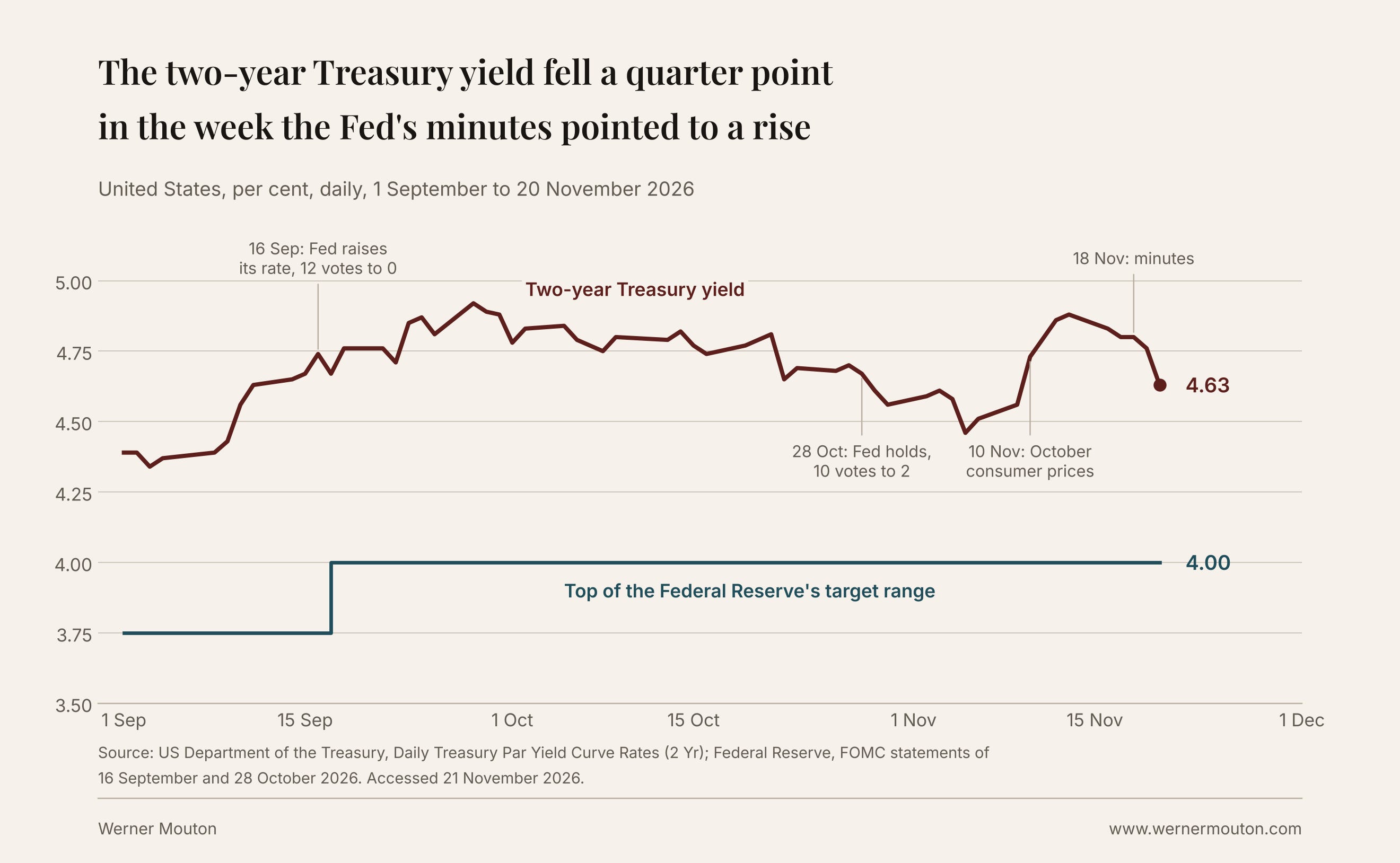
The yield on the United States Treasury’s two-year notes is the price of two-year money for the government and the base for much business credit. It closed at 4.88 per cent on 13 November and at 4.63 per cent a week later. A quarter of a point is the size of one rate rise. The minutes describe the same turn in October, when yields fell back as investors doubted the revenues of AI firms.
Australia’s central bank began earlier. It has raised its rate five times this year, and at the fifth, on 3 November, three of its nine board members voted to hold. Its minutes record their concern that the economy might be near “a materially sharper downturn”.
The Federal Reserve has raised rates into a technology boom before, and Barr made the comparison: the firms’ debt, he said, recalls the telecom build-out of the late 1990s. The committee made its sixth rise in eleven months on 16 May 2000. It began to cut on 3 January 2001.
I think Warsh is right that rates reach the AI boom, and his committee’s own record says they will reach it through debt that is hard to see. I think the committee raises its rate by a quarter point on 9 December.
Bank Indonesia and the rupiah
On 18 November Bank Indonesia raised its policy rate by a quarter point to 6 per cent. Inflation in Indonesia was 3.23 per cent in October, inside the bank’s target, and growth had quickened in the third quarter. The bank’s statement gives another reason. The rise is to steady the rupiah, and from here the bank “will consistently orient monetary policy towards strengthening Rupiah exchange rate stability”. Of the world outside, it says that investors expect the Federal Reserve to raise its rate, that Treasury yields are high and that investors have cut their holdings in emerging markets. Governor Destry Damayanti told reporters that the move answered the chance of a Fed rise in December and that a rate rise alone was not enough, and the bank made it cheaper for firms to hedge the currency. Six days earlier the vice-president, Gibran Rakabuming Raka, had resigned. The Fed’s committee meets on 8 and 9 December. Bank Indonesia moved three weeks ahead of it.
October’s inflation rate
On 10 November the United States Bureau of Labor Statistics reported that consumer prices rose 0.4 per cent in October. Bond buyers sold, and the two-year Treasury yield rose that day and on the next trading day. The release gives no annual rate. The bureau collected no prices in October 2025, when its funding lapsed, and with no figure for that month it cannot say how far prices rose over the year. Its release on pay has the same gap: hourly pay and prices rose by the same amount in October, and the bureau gives no change in real pay over twelve months. A monthly rise of 0.4 per cent, kept up for a year, comes to 4.9 per cent, but one month is one month. Any annual rate for all prices that a reader has seen for October was worked out by someone else. The Fed’s committee decides on 9 December. The bureau publishes November’s prices on 10 December.
One last chart: the two parts of the ten-year yield
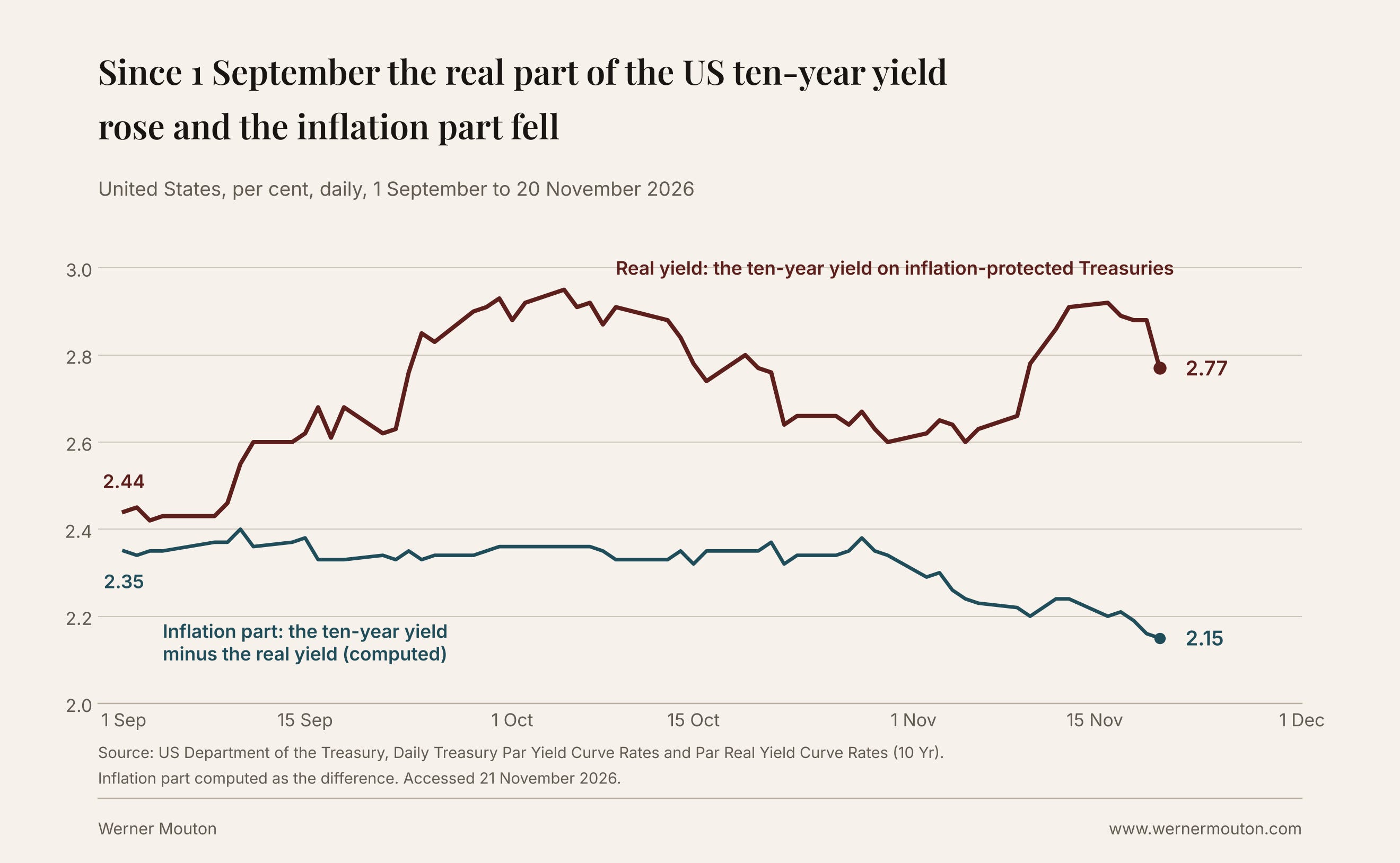
The United States Treasury sells two kinds of ten-year bond. One pays a fixed rate. The other pays a rate on top of consumer-price inflation, and its yield is the real yield. Take the second from the first and what is left is the inflation rate at which the two bonds pay the same. Since 1 September the real yield has risen from 2.44 to 2.77 per cent. The inflation part has fallen from 2.35 to 2.15.