

What is a bond, and why does its price fall when yields rise?
On 10 November the US Treasury sold $42 billion of new ten-year notes. Each note pays 5% a year on its face value until November 2036 and then pays the face value back. The buyers asked for 5.02%, so they paid about $99.84 for every $100 of notes. The coupon, the yield and the price all sit in that one sale.
A bond is a loan that can be sold. A government or a company borrows from investors and promises interest on fixed dates and the full amount back on a final date. The investor who holds the bond owns that promise. He does not own a part of the borrower.
Take a bond with a face value of $1,000 and a coupon of 5%. The borrower pays $50 a year and repays $1,000 at the end. Those payments are fixed on the day the bond is issued. If the first buyer sells the bond to someone else, the borrower still pays $50 a year, now to the new owner.
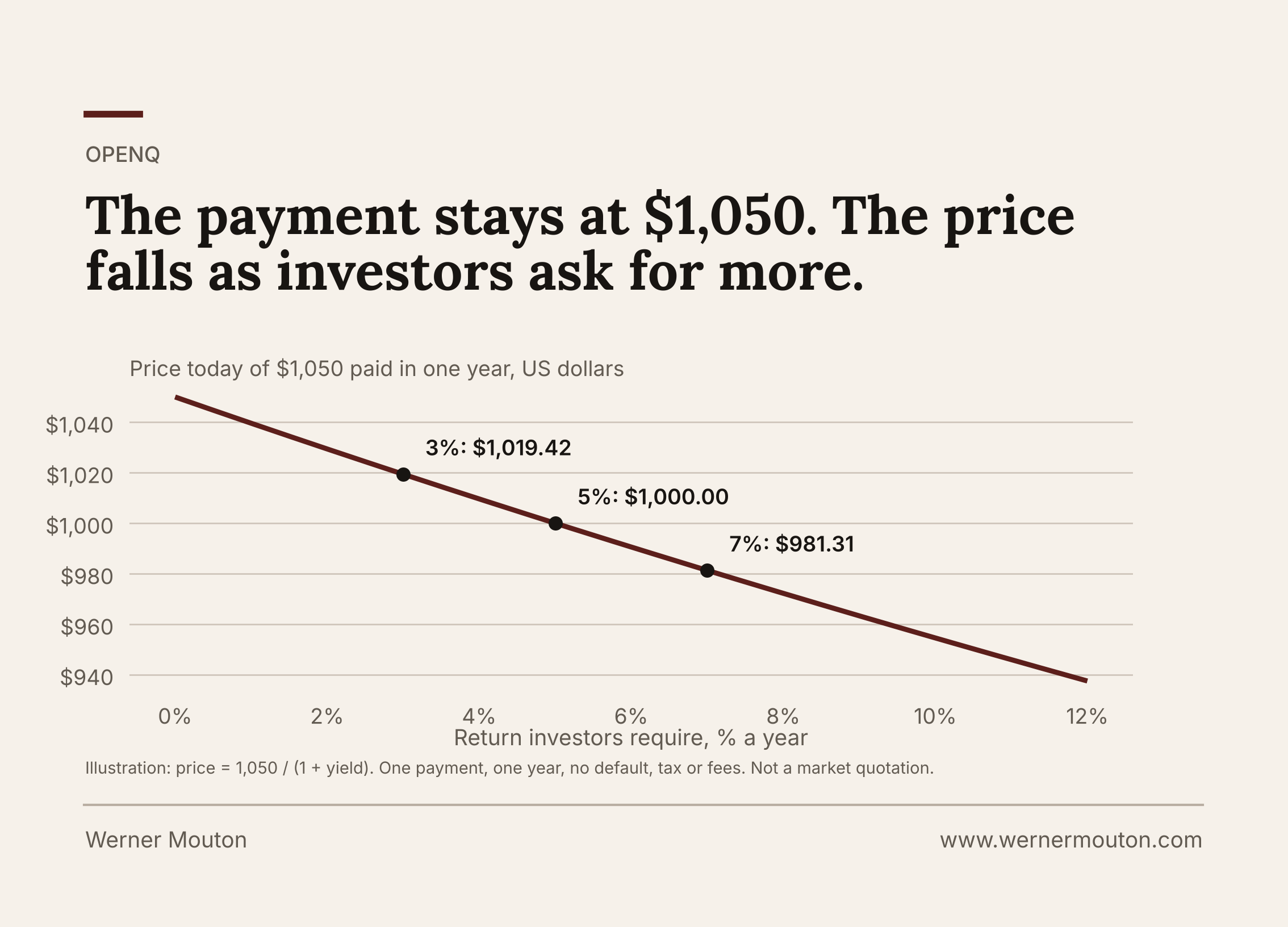
The price the new owner pays is not fixed. Suppose one year remains, so the bond will make one last payment of $1,050. If investors can earn 5% elsewhere, they will pay $1,000 for it, because $1,000 that grows by 5% becomes $1,050. If they can earn 7% elsewhere, they will pay $981.31. At that price the $1,050 gives them their 7%. If they can earn 3%, they will pay $1,019.42. The payment does not change, so the price has to. The return a buyer earns at the price he pays is called the yield.
The coupon is the rate printed on the bond. The yield is what today’s buyer earns at today’s price. In August the Treasury sold a ten-year note with a coupon of 4.625%. A buyer who wants 5.02% today will pay about $97 for each $100 of that note. A report that US ten-year yields have risen to 5% means buyers now pay less for the government’s old promises.
For a ten-year note the sum has more steps, because each of its twenty half-yearly coupons is valued from its own date. The direction is the same, and the price falls further for the same rise in yield.
The holder and the borrower feel a rise in yields in different ways. The holder of the August note owns a promise that is worth less if he sells today. If he keeps it to 2036 and the Treasury pays, he still receives every dollar he was promised. The Treasury pays nothing extra on the old note. It pays the higher rate when it borrows again, and it borrows every week. In the year to September the federal government paid $1,142 billion in net interest on its debt, $114 billion more than the year before. The Congressional Budget Office put the rise down to a larger debt and higher long-term rates. That is about $3.1 billion a day, paid to the people and institutions that hold the debt.
The OpenQ
On 4 November the Treasury said it “anticipates maintaining nominal coupon and FRN auction sizes for the next several quarters.” In August the same statement said “for at least the next several quarters.” Two words went, and the change leaves room for larger auctions. The deficit for the year to September was $2.0 trillion. The open question for the next six months is whether buyers will take more American debt at 5% or ask for more, and push down the price of every old note and push up the cost of every new dollar the government borrows.
Think About
A rise in yields moves money between people. Holders of old bonds lose if they sell, new lenders earn more and taxpayers pay the higher rate for ten or thirty years on each new loan. Congress sets taxes and spending, but the rate the government pays to borrow is set at auction by whoever turns up to bid. Who should set the price a democratic government pays for money, and who should receive the more than $1 trillion a year it now pays in interest?
Ask or Reply
Send your answer or email me a question for a future OpenQ at info@wernermouton.com.