When Peace Means Insurance
When Peace Means Insurance
When Peace Means Insurance
Donald Trump announced the end of the war with a social-media flourish: ships should start moving again and oil should flow. It was the kind of sentence that reduces a political settlement to a switch. War blocks the passage. Peace opens it. A president speaks, markets move, tankers return, prices fall and the world goes back to where it was.
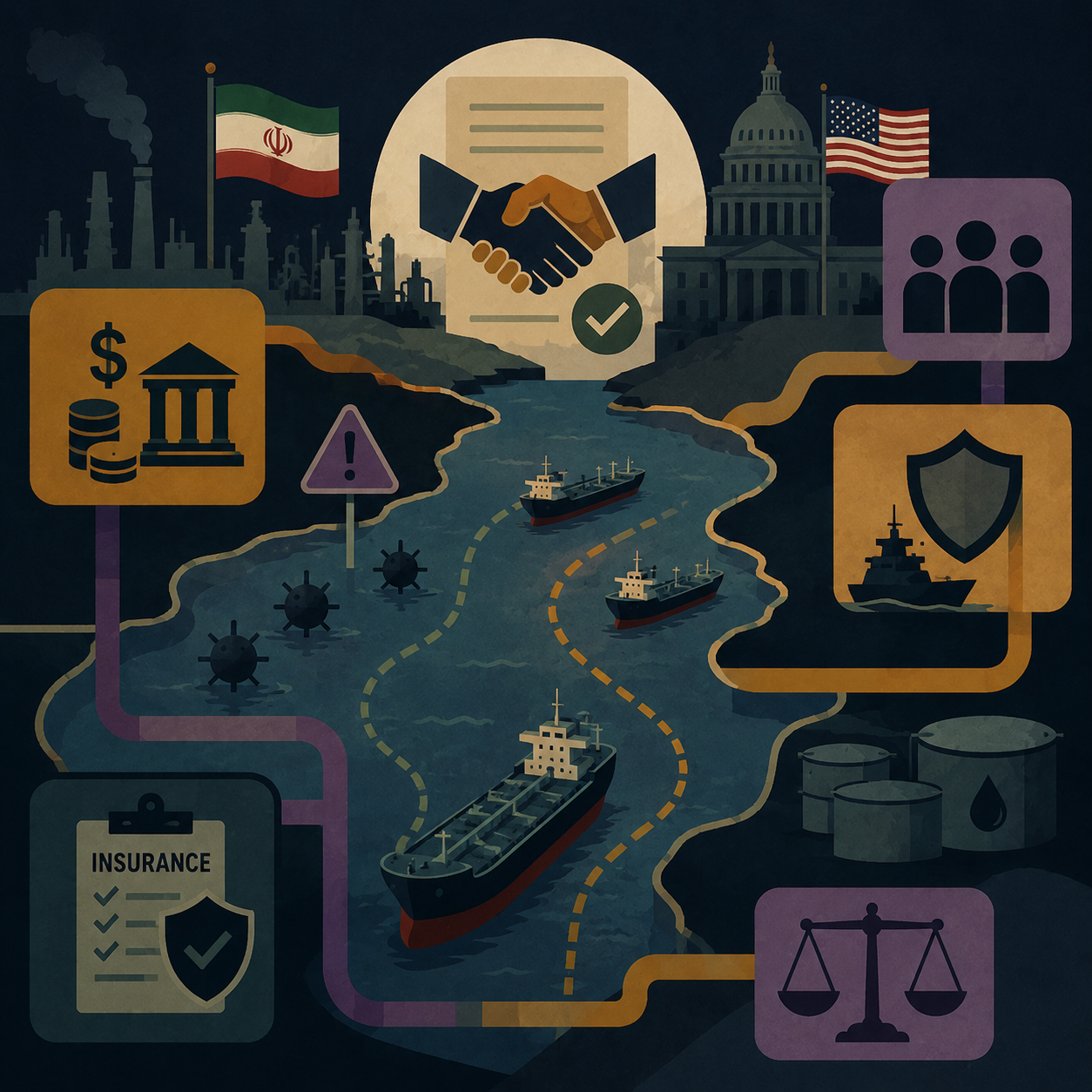
But the Strait of Hormuz does not reopen because a president says it has reopened. A strait reopens when crews agree to sail, when insurers agree to cover risk, when shipowners believe a route is safe enough, when mines are cleared or avoided, when navies know who is responsible for what, when sanctions lawyers decide a payment or service will not expose a company to penalties, when oilfields restart and when storage tanks are emptied in the right order. The first sign of peace may be a falling oil price, but the substance of peace is administrative. It is written into waivers, premiums, shipping notices, naval deployments, inspection regimes, parliamentary authorisations and the quiet calculations of companies that have to decide whether the risk is now tradable again.
This is the more important story inside the US-Iran agreement. The deal may stop the immediate war, or at least suspend it. It may create sixty days of space for a wider settlement. It may allow Iranian oil to move again and it may give Washington a way to say that the war forced Iran back to the table. But it does not restore normality. It transfers the war from the visible field of strikes and retaliation into the machinery that makes global commerce possible.
That machinery is usually hidden because it works. Oil leaves the Gulf. Ships pass through narrow waters. Insurance exists in the background. Naval power is assumed. Sanctions are treated as a legal layer rather than as a weapon. The price of crude appears on a screen as if it were simply the result of supply and demand. But a crisis in Hormuz makes the whole system visible. It shows that the world economy still rests on physical routes, military guarantees, legal permissions and a fragile confidence that ships can move without becoming targets.
The deal with Iran is therefore not only a diplomatic settlement. It is an attempt to convert military danger into commercial risk. That distinction matters. Military danger stops trade because ships can be hit, crews can die and cargo can burn. Commercial risk does not remove danger. It prices it, distributes it and decides who will carry it. A war that cannot be tolerated by markets is not necessarily ended by politics. It may be absorbed by insurance.
That is why the first reaction in oil markets is only the beginning of the story. Prices fell because traders began to price a reopening of Hormuz. They were not pricing trust. They were pricing a path by which barrels might move again. Markets often move before the machinery catches up. A price can adjust in seconds, but a tanker fleet cannot. A contract can anticipate supply, but a damaged gas plant still has to be repaired. A peace framework can lower the fear premium, but it cannot refill strategic reserves, restart old wells, clear mines, reassemble crews, relocate ships and rebuild the confidence of underwriters in London.
The war created a physical problem before it became a financial one. Oil and gas production was shut in because export routes were blocked or too dangerous. Storage filled. Tankers scattered or waited in the wrong places. Some vessels sat loaded. Others stayed outside the Gulf. Companies that had learned to treat Hormuz as an artery suddenly had to treat it as a contested corridor. The result was not simply a shortage of oil. It was a disordering of the system that moves oil from the ground to the refinery and from the refinery into prices, budgets and inflation.
This is why the promise of flowing oil is too simple. Oil does not flow by will. It flows through a sequence. Wells have to produce. Pipelines and terminals have to function. Export tanks need room. Empty tankers have to enter before loaded tankers can leave in regular volume. Crews have to be available. Insurers have to judge the passage. Navies have to secure or monitor the route. Buyers have to know that cargoes will not become legal or military liabilities halfway through the journey. A single break in that sequence can delay the whole return to normal.
The deeper question is who now governs that sequence. Before the war, freedom of navigation through Hormuz was treated as part of the background order. It was not uncontested in law or politics, but it worked well enough to be taken for granted by markets. The closure changed that. The crisis showed again that a chokepoint is a form of power. The United States learned that it could not secure the global energy system without also negotiating with the state that can disrupt it. Europe learned that opposing a war does not protect it from the costs of the war. Shipowners learned that open water can become a sanctions problem. Consumers learned nothing directly, but the cost still moved toward them through fuel, freight, inflation and public budgets.
Iran’s leverage in this settlement comes from that narrowness. It could not defeat the United States in a conventional military sense, but it could make the world pay attention to a passage the world had treated as infrastructure. By choking Hormuz, Iran turned geography into bargaining power. The US response now appears to be financial as much as military. Sanctions relief, oil export waivers, frozen assets and development financing are not side issues. They are the language in which pressure is being converted into settlement. Iran is asked to trade disruption for reintegration. Washington is trying to turn a war into an economic bargain.
That bargain carries political danger for both sides. For Iran, compromise cannot look like capitulation. The state needs to show that it gained something material from resistance: oil sales, money, development, recognition, time. For Trump, the deal must look tougher than the agreement he once condemned. It must look like victory even if it uses familiar instruments: limits, talks, relief, verification and staged incentives. The contradiction is obvious. The United States can now present the war as the pressure that forced a better deal, while the better deal may require giving Iran broad financial gains in return for restraint.
This is not unusual in international politics. Wars often end through payments that cannot be called payments, concessions that cannot be called concessions and compromises described as enforcement. What is striking here is how openly the settlement depends on the economy. The war did not end because the underlying hostility disappeared. It ended because the costs of continuing had begun to move through the global system. Oil prices, shipping disruption, strategic reserves, Asian imports, European pressure, Gulf diplomacy and the risk of further escalation all pressed on the battlefield. The final deal may be signed by states, but it was prepared by the balance sheets around them.
The mediators understood this before the public announcement. Qatar and Pakistan were not merely carrying messages between enemies. They were trying to hold open a narrow path between distrust and economic necessity. The diplomacy had to survive strikes, deadlines, Israeli action, Iranian suspicion and Trump’s impatience. That matters because it tells us what kind of peace this is. It is not a peace built on reconciliation. It is a peace built on exhaustion, leverage and the need to make the system usable again.
This is why the role of the Gulf states is so important. They are not neutral spectators to a distant conflict. They sit inside the infrastructure of the settlement. Qatar has experience as a channel to adversaries. Saudi Arabia and the United Arab Emirates have direct interests in stabilising energy flows. Their leaders had reason to push Trump away from further strikes because another strike could undo the diplomatic work and extend the damage to the region’s own economies. The Gulf states were protecting more than peace. They were protecting the operating system through which their power, revenue and global importance move.
Europe is in a different position. It opposed or avoided the war, but it could not avoid the aftermath. European leaders have been forced into the awkward role of flattering the American president while preparing to help clean up the consequences of a conflict they did not control. Britain, France, Italy and others may send ships, minesweepers or support vessels. They may help secure passage once the ceasefire appears stable enough. They may debate sanctions relief and the legal shape of the settlement. But their role is not sovereign in the heroic sense. It is managerial. Europe is being asked to help administer a route whose closure damaged its economies and whose reopening depends on American, Iranian and Gulf decisions.
That is the structure of European weakness here. Europe can criticise the war, but it still needs the route. It can dislike Trump’s conduct, but it still needs Washington on Ukraine. It can speak of international law, but it may have to provide ships to make commerce possible under the shadow of force. The result is a diplomacy of discomfort. European leaders smile at the G7 because they do not have an alternative system to stand on. They can see that the transatlantic relationship has changed, but they still have to work inside it.
The Strait of Hormuz becomes the place where all these dependencies meet. It is a passage of water, but it is also a diagram of the world economy. Iranian power sits on one side of it. Gulf producers depend on it. Asian buyers need what passes through it. European economies feel the price of disruption. American military power has long helped secure the order around it, but American politics now makes that guarantee unstable. Shipowners and insurers translate this instability into decisions. A mine, a missile, a sanction, a premium and a diplomatic phrase all enter the same calculation.
The argument over tolls or fees shows how quickly military conflict becomes institutional conflict. If Iran charges for passage, is that a toll, a fee for services, an illegal demand or a sanctions violation? The answer is not semantic. It determines whether companies can pay, whether insurers will cover ships, whether the US will punish firms, whether Iran can monetise its geography and whether the strait remains part of a global commons or becomes a managed passage under regional power. A few words in a memorandum can decide who captures value from a route that the world has treated as open.
This is where peace becomes insurance. Not only in the literal sense of war-risk premiums, though those matter. Peace becomes insurance in the broader sense that the system does not require full trust. It requires calculable risk. The shipowner does not need to believe that Iran and the United States have resolved half a century of hostility. The shipowner needs to know whether a vessel can pass, whether the crew will sail, whether the cargo is covered, whether the legal exposure is manageable and whether the next missile exchange is unlikely enough to make the voyage worth it. The insurer does not certify peace. It prices uncertainty.
That is a cold measure of world order, but it may be the most honest one. Much of globalisation has operated this way. It does not abolish violence. It routes around it when possible and prices it when necessary. It relies on force, but prefers force to remain in the background. It turns political conflict into risk categories, compliance decisions, shipping costs and supply contracts. The consumer sees a price. The state sees strategic vulnerability. The company sees exposure. The insurer sees a premium. The navy sees a corridor. The market sees a spread between fear and confidence.
The danger is that this produces false comfort. A falling oil price can make the crisis look finished before the structure has changed. The announcement of an agreement can make the world appear safer before ships have returned in normal numbers. A ceasefire can become a market event before it becomes a political fact. But the war has left behind damaged infrastructure, depleted reserves, altered trade routes, new bargaining positions and doubts about who will enforce what. Even if Hormuz reopens, it will not be the same passage it was before the war. It will be watched differently, priced differently and governed through a new memory of interruption.
The comparison with the Red Sea is useful because it shows how routes do not automatically recover when the headline danger recedes. Once shipping companies learn that a corridor can become unsafe, they do not return only because a deal has been announced. They wait for evidence. They look at attacks, naval commitments, insurance rates and the behaviour of other firms. Traffic can remain below old levels long after officials claim the route is usable. A passage can be formally open and commercially impaired at the same time.
That may be the future of Hormuz. Not closed, but not normal. Not at war, but not at peace. Open enough for some oil to move, risky enough for premiums to remain high, stable enough for prices to fall, fragile enough for every incident to matter. The world may call this de-escalation because the alternative is worse. But de-escalation is not restoration. It is the creation of a managed uncertainty.
This is also why the nuclear question cannot be separated from the shipping question. The public language of the deal may focus on Iran’s commitment not to seek a nuclear weapon, but the immediate pressure came through energy. Nuclear limits, sanctions relief and Hormuz navigation are now tied together because each side needs leverage over the others. Iran’s enriched uranium, its oil exports, its access to money and its control over disruption are parts of one bargaining field. The United States wants to separate the issues into enforceable conditions. Iran wants to ensure that any concession produces material relief. Markets want the passage open. Allies want the war contained. Each demand presses on the same document.
The result is a settlement that may succeed only if it remains narrow and practical. It does not need friendship. It needs sequence. First the signing. Then enough calm for ships to move. Then enough evidence for insurers to lower premiums. Then enough tanker traffic to clear storage. Then enough exports to restart production. Then enough political discipline to prevent Israel, Iran, Hezbollah, the United States or another actor from breaking the frame. Then enough progress in talks to keep sanctions relief alive. At each stage, peace has to be reproduced through action. It is not a state of being. It is a process.
The world economy is built on such processes. That is what the war revealed. We often speak of global markets as if they float above politics, responding to information with speed and abstraction. But under every price there is a material chain and under every material chain there is an institutional order. Oil has to be pumped, stored, shipped, insured, financed, refined and delivered. Each step depends on rules and force. The market price is the visible surface of that arrangement. Hormuz is one of the places where the surface cracks and the machinery shows.
The lesson is not that oil is uniquely fragile. It is that the world remains more physical than its financial language suggests. Routes matter. Ports matter. Crews matter. Mines matter. Naval guarantees matter. Insurance clauses matter. Sanctions offices matter. A corridor of water can pull central banks, parliaments, energy companies, shipping firms, militaries and households into the same event. War travels through the world economy not only as destruction, but as a change in the cost of movement.
When peace comes, it travels the same way. Not as a moral condition, but as the lowering of specific frictions. The premium falls. The waiver is issued. The mine channel is cleared. The tanker enters. The storage tank empties. The refinery receives cargo. The price adjusts. The budget breathes. The politician claims success. But each of these steps is reversible. Each depends on a confidence that did not exist before the war and cannot be recreated by announcement alone.
This is the settlement now being attempted in Hormuz. The war is being pushed out of the headlines and into the institutions that manage risk. That may be enough to prevent another immediate shock. It may be enough to lower oil prices and give negotiators room. It may even become the beginning of a more durable arrangement. But it should not be mistaken for a return to the old order.
The old order depended on the assumption that the artery would remain open because too many powerful actors needed it open. The war showed that need alone does not guarantee passage. Someone must secure it. Someone must price it. Someone must insure it. Someone must accept the risk. Someone must pay when the risk rises.
The Strait of Hormuz will probably reopen before the war is truly over, because the world cannot wait for trust before it needs oil. That is the real settlement being attempted: not peace as reconciliation, but commerce made possible again under armed supervision.