A Quota Cannot Open a Strait
A Quota Cannot Open a Strait
A Quota Cannot Open a Strait
On 2 August, officials from seven oil-producing countries met by video. The group brought Saudi Arabia and Russia together with Iraq, Kuwait, Kazakhstan, Algeria and Oman. They agreed to raise their combined production target by 188,000 barrels a day in September. Their statement spoke of market stability, compliance and compensation for earlier overproduction. It was the language of a system that still works through tables, monthly meetings and agreed numbers.
The oil itself belongs to another world.
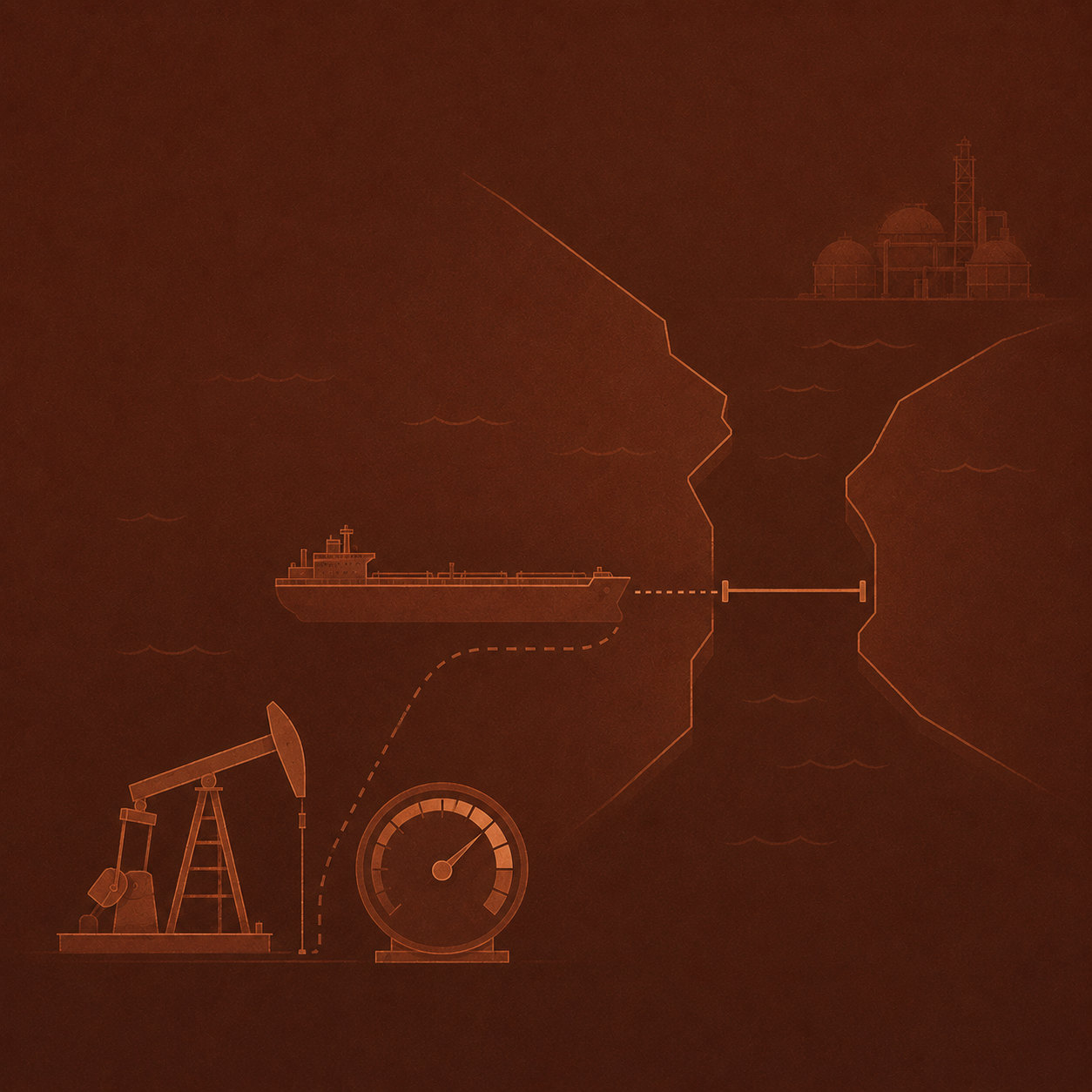
OPEC+ can assign a country the right to pump more crude, but it cannot make the sea safe. The Strait of Hormuz remains largely closed during the war with Iran, and the threat to shipping near the Bab el-Mandeb has not disappeared. Oil from the Gulf must pass through narrow stretches of water before it reaches a refinery. Russian and Kazakh exports face their own disruptions. A production target settled on a screen in August may therefore bear little relation to the fuel available to a buyer in September.
The gap is already large. According to figures cited by Reuters, the eight OPEC members governed by quotas produced 20.276 million barrels a day in June. That was 6.246 million barrels below their combined target. Russia produced 8.928 million barrels a day, almost one million below its allowance. These figures do not mean that every missing barrel was trapped by war or shipping. They do show that the quota has stopped being a reliable description of supply.
This is the limit exposed by the present crisis. For years, OPEC+ appeared to control the oil market at the wellhead. Its members withheld barrels, restored them and watched the price respond. But oil has no practical value to an importing country until it can leave a terminal, obtain insurance, cross the sea and enter a refinery. Power now sits along the entire route: with port authorities, pipeline operators, insurers, shipping companies, armed forces and the states that control the coast.
President Trump has encountered the same fact from another direction. He has often treated the conflict with Iran as a test of force followed by a deal. The United States and Israel began strikes in February. An attack on 28 February killed Iran’s supreme leader, Ali Khamenei. Trump called on Iranians to remove their government and said that he would choose the next leader. No uprising followed. Iran’s political and military system appointed Khamenei’s son, Mojtaba, and continued the war.
The Strait has now become part of the negotiation. American officials say an agreement to reopen it may be near, but Iran insists that it should be allowed to collect passage fees. Trump rejects that demand. He has expressed anger that Tehran continues to resist after the force used against it.
Yet Iran’s leaders do not appear to understand survival, defeat or compromise in the same way that he does. The state rests on institutions built over nearly half a century, a military command closely tied to religious authority, and an account of national independence formed partly through opposition to the United States. Killing senior leaders did not remove that structure. It may have strengthened the people within it who believe resistance is the source of their authority.
This does not make Iran inscrutable, and it does not make its conduct reasonable. It means that American power has not produced the quick political result Trump expected. Iran still holds one of the few instruments capable of reaching households far beyond the battlefield. By restricting a waterway through which a large share of the world’s oil and liquefied natural gas normally moves, Tehran can place a cost on governments that have no part in the war. Its leverage arrives through petrol prices, electricity bills, shipping charges and food carried by truck.
The OPEC+ increase should be read against this struggle. It cannot replace barrels that cannot travel. Saudi Arabia can send some crude westward through a pipeline to the Red Sea, and the United Arab Emirates can move some exports to the Gulf of Oman, but those routes cannot simply reproduce the normal flow through Hormuz. Nor does a higher target repair a damaged port, find a willing insurer or protect a tanker crew.
The decision still matters. It completes the return of 1.65 million barrels a day that the group began withholding in 2023. If a durable agreement reopens the sea, the seven producers will be entitled to raise output just as Iranian exports and other disrupted supplies may return. The market could move quickly from scarcity to abundance.
Oil prices would fall, helping importing countries and households but reducing the income of producer states whose budgets depend on each exported barrel. The small September adjustment is therefore also preparation for the peace that has not yet arrived.
This places OPEC+ in an unusual position. It is managing two different times. In the present, the organisation announces supply that war may prevent from reaching the market. In the future, it is arranging who may sell how much when ships can move again. The quota is weak as a remedy for today’s shortage but important as a claim on tomorrow’s revenue.
People experience neither of these problems as an OPEC table or a dispute over maritime law. They meet them at the petrol station and the shop. Governments in poorer importing countries must decide whether to subsidise fuel, borrow more money or pass the increase to households. Transport costs enter the price of bread and other ordinary goods. A distant conflict becomes a smaller meal or another bill left unpaid.
OPEC+ has added 188,000 barrels a day to a production plan. Whether those barrels matter will be decided outside the meeting: in Tehran and Washington, at ports and pipelines, on the decks of tankers and in the narrow water between Iran and Oman. The producers can decide how much oil they are willing to pump. They cannot, on their own, deliver the passage that gives the barrel its price.
Thank you for reading. If you find this work valuable, you can help make more of it possible by becoming a member.