SpaceX’s First Lock-Up Test
SpaceX’s First Lock-Up Test
SpaceX’s First Lock-Up Test
On Thursday, 6 August, about 911.5 million SpaceX shares held by employees and early investors will become eligible for sale.
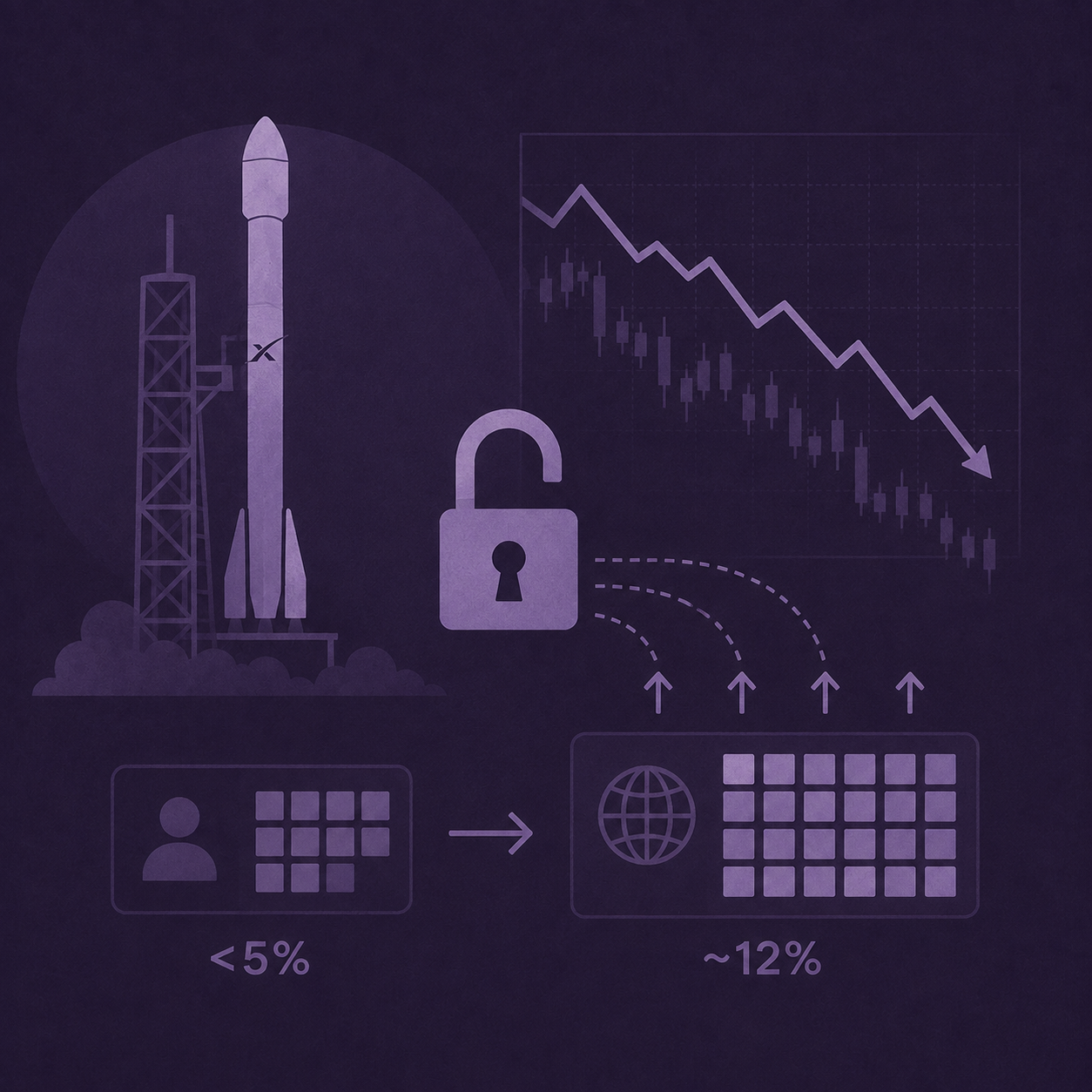
The shares do not have to be sold. Many will remain with their current owners. But the amount of SpaceX stock available for public trading will rise from less than 5 per cent of the company to more than 12 per cent.
That is an almost threefold increase in the potentially tradable float.
The first lock-up release comes only weeks after SpaceX went public. The company sold a small part of itself in the initial public offering and raised about $86 billion. Existing shareholders did not sell stock in the offering. Most of the company therefore remained in the hands of founders, employees and early investors.
This limited supply helped shape the market from the start. Investors were trying to buy a small public slice of a very large company. When demand met such a narrow float, the share price rose quickly. It later fell sharply and now trades below the $135 offering price.
Thursday changes the supply side of that market.
The business itself will not change. SpaceX will still have the same rockets, satellites, contracts and long-term plans. But a far larger number of shares will be allowed to trade. That matters because a stock price depends not only on what investors think a company is worth. It also depends on how many shares buyers must absorb at any given time.
Employees and early investors may have strong reasons to sell.
Some have held their shares for years. Their wealth may be tied almost entirely to one company. Selling part of a position would allow them to buy a home, pay tax, settle debt or spread their money across other assets. An employee can believe in SpaceX and still decide that holding most of his or her wealth in one stock is too great a risk.
This makes the lock-up difficult to read.
Heavy selling would not necessarily mean that insiders have lost faith in the company. Limited selling would not prove that they think the current share price is cheap. Each shareholder has different needs, costs and expectations. The market will see the volume of selling, but it will not always know the reason behind it.
SpaceX and its banks tried to manage this uncertainty through a staggered lock-up.
Most public companies prevent insiders from selling for about 180 days after an initial offering. When that period ends, a large amount of stock can become available on one date. SpaceX chose a different structure. Shares will be released in several stages over the next ten months.
The first portion becomes available after the company’s first earnings announcement. Another large group of shares will be released after the company reports its third-quarter results. Elon Musk and some major investors remain restricted for longer.
The aim is clear. A gradual release may be easier for the market to absorb than one very large block of shares.
But the arrangement may create another problem. Investors know that more stock will become available after each release. A buyer may wait for the next tranche. A fund planning a large purchase may expect better liquidity and a lower price later. Existing shareholders may sell before the next increase in supply.
The staggered schedule could therefore spread the pressure over several months rather than concentrate it on a single day.
The market has already reacted. SpaceX shares have fallen by almost half from their early high. Short interest has also risen sharply, with investors borrowing shares and selling them in the expectation that they can buy them back later at a lower price.
This does not mean the share price must fall on Thursday.
The lock-up is public knowledge. Investors have had time to prepare for it. Some of the expected selling may already be reflected in the current price. If fewer insiders sell than the market expects, the stock could stabilise or rise. The large short position could also add upward pressure if traders rush to close their bets.
The more important question is what happens after Thursday.
SpaceX entered the market with fewer than one share in twenty available for trading. That scarcity helped separate the public share price from the ownership structure of the wider company. The first lock-up release begins to narrow that gap.
The stock will now face a broader market test. More insiders will be able to sell. More institutional investors will be able to build positions. Trading volume may rise, and the share price may begin to reflect a larger balance between buyers and sellers.
Thursday may bring a sharp move. It may also pass with less selling than expected. But the increase in available shares will not end there. Further releases will follow, and each one will test how much demand exists once scarcity plays a smaller role.
Thank you for reading. If you find this work valuable, you can help make more of it possible by becoming a member.