Weekly Global Markets: Oil, borrowing costs and uneven prices

Weekly Global Markets: Oil, borrowing costs and uneven prices
Weekly Global Markets: Oil, borrowing costs and uneven prices
10 October 2026 · Week of 5–9 October
Brent crude settled on Friday 9 October at $104.72 a barrel, up 2.4% on the week. The US ten-year Treasury yield ended at 5.261%, down 3.5 basis points over the week. Oil rose and the cost of long US borrowing fell, and both stayed high. The Federal Reserve had raised its target range to 3¾–4% in September. The European Central Bank had raised its deposit rate from 2.00% to 2.50% across June and September. The week turned on whether those rises were enough, and on where the energy shock was spreading.
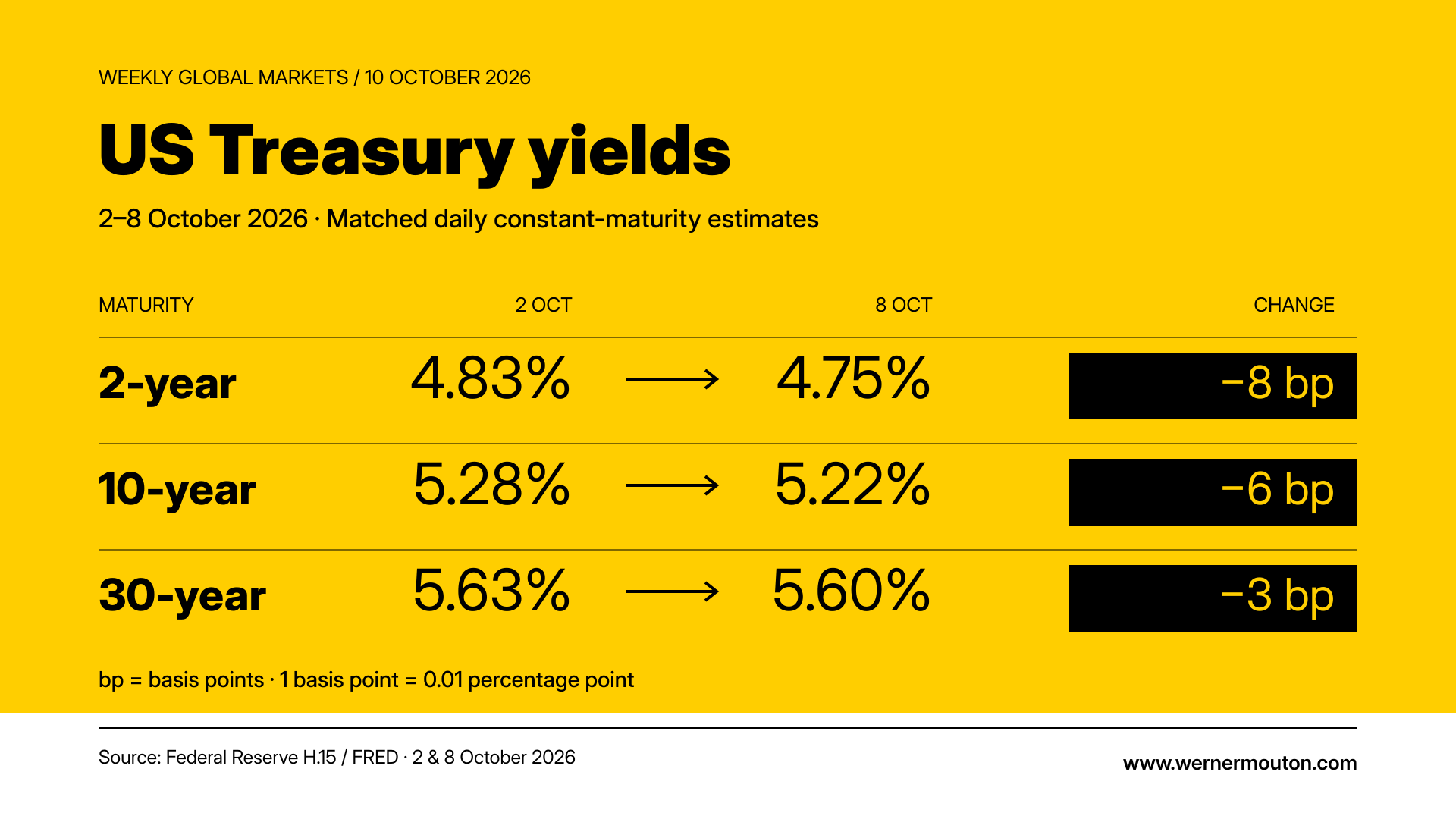
The Fed's daily figures run from Friday 2 October to Thursday 8 October. They are constant-maturity yield estimates, compared on the same dates, rather than closing prices on particular bonds. The ten-year yield fell from 5.28% to 5.22%. The inflation-indexed ten-year fell from 2.92% to 2.87%. The gap between them, a rough price for expected inflation, moved from 2.36% to 2.35%. That gap also carries risk and the ease of trading, so it is not a clean forecast.
The Fed's daily figures
Most of the ten-year fall came with a fall in the inflation-indexed yield. The gap barely moved. That cuts against the idea that traders made a large change to their view of long-run inflation. The thirty-year fell 3 basis points and the two-year fell 8 over the same dates. Short money eased and long money stayed dear. Those moves alone do not establish a new loss of faith in US public finances.
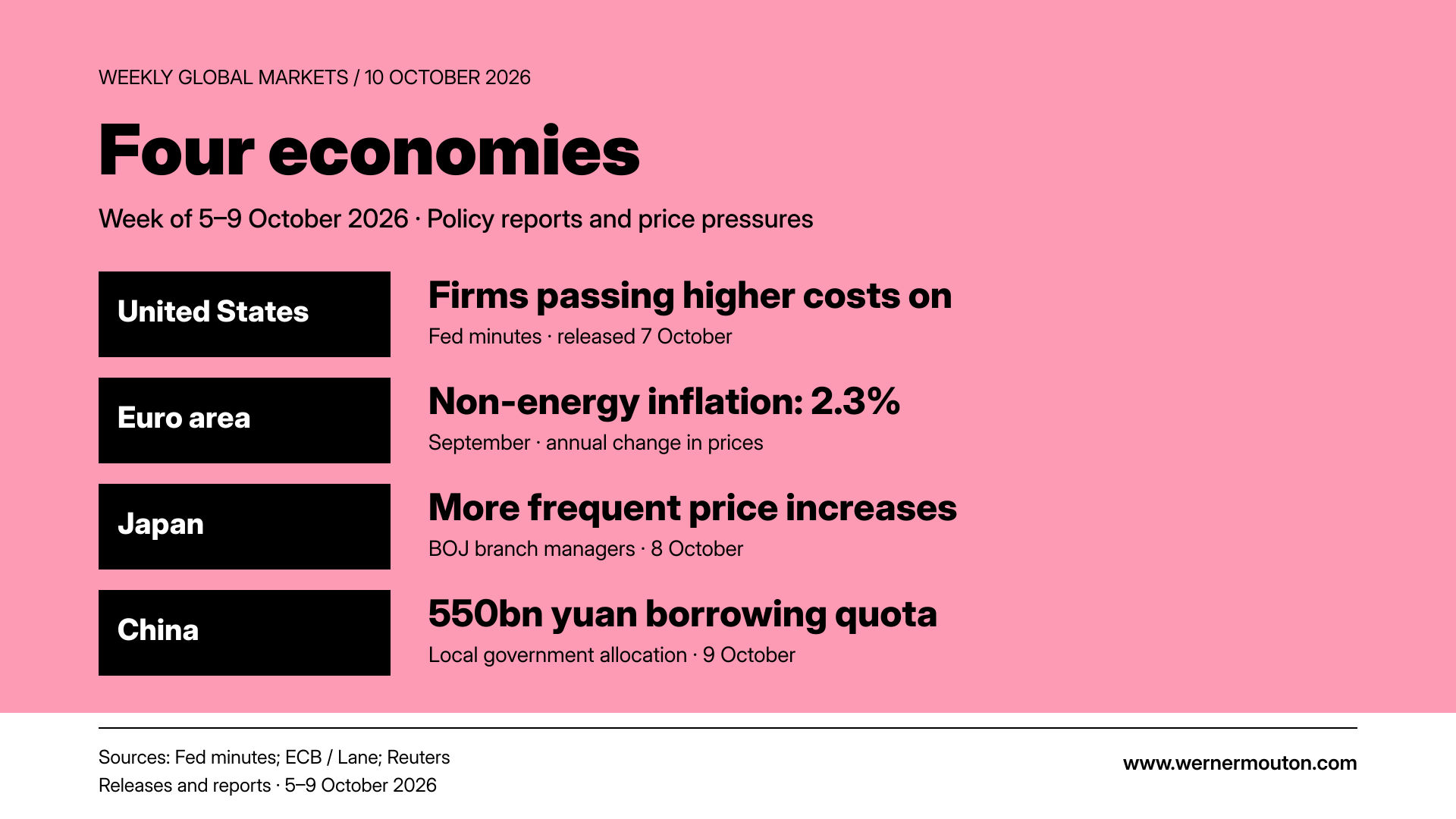
On 7 October the Fed published the minutes of its September meeting. Officials pointed to strong spending on artificial intelligence, steady pressure from energy, and an economy still growing. They judged long-run inflation expectations to be in line with their target. Most expected another rise in the rate to be appropriate by the end of the year. Fed staff had estimated August PCE inflation at 3.8% and core inflation at 3.4%. The later BEA release, published on 30 September, put those figures at 3.4% and 3.0%. Some officials said firms had become more successful at passing higher costs on to shoppers. These were September views, made public this week.
ECB
The same minutes drew a distinction between borrowers. Large firms could still raise money on broadly favourable terms. Home buyers and small firms found it harder. A company with strong earnings and access to the bond market can keep building at a rate that stops a family from buying a house. High yields need not halt investment at once. They help determine who gets the money.
Reuters also reported a mechanical force. Investors buying large corporate bond issues hedged their interest-rate risk through the Treasury market, and investors holding mortgage assets hedged too. That selling can sharpen a day's move with no change in the outlook. Reuters did not measure how much of the week it explains.
Oil met a physical limit. Friday's trade weighed the prospect of fewer immediate US strikes on Iran against Hurricane Isaias in the Gulf of Mexico. Reuters reported that more than 70% of offshore crude output in US waters had been shut in. The shut-in was a precaution, not a count of damage.
Crude and fuel moved apart. The Energy Information Administration reported on 7 October that commercial crude stocks fell from 427.320 million barrels to 424.134 million in the week to 2 October. Gasoline stocks rose a little. Both figures came before the hurricane shutdowns. Refineries, fuel stocks and shipping routes stand between the price of crude and the price at the pump.
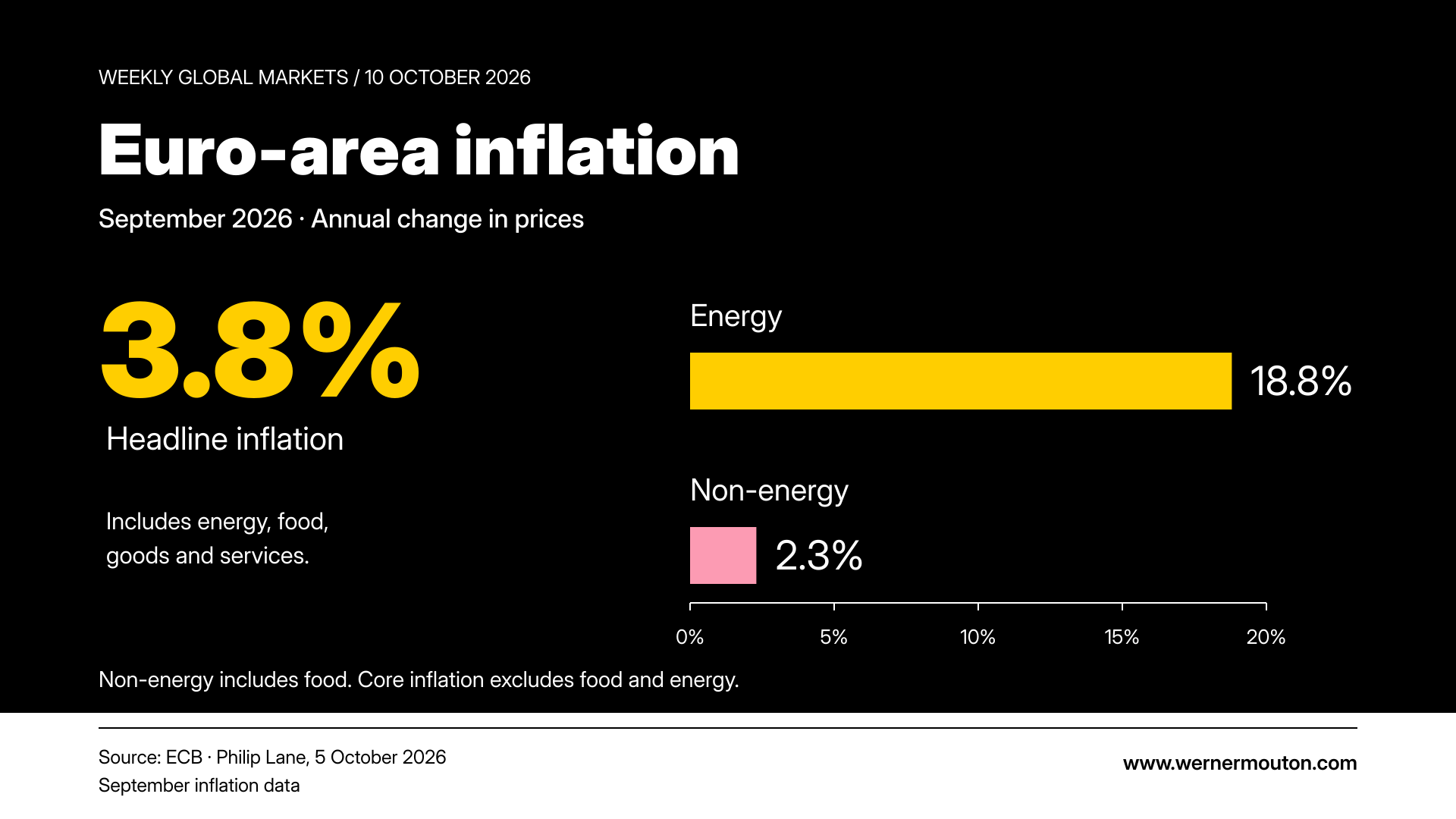
The euro area's figures look different from America's. On 5 October the ECB's chief economist, Philip Lane, gave September headline inflation at 3.8%. Energy was up 18.8%. Prices outside energy were up 2.3%, a slightly lower rate of increase than in the last quarter of 2025. Core inflation had moved from 2.4% to 2.5%. The latest published US core PCE figure was half a percentage point higher, though it covered August and used a different price index. In the euro area the rise in headline inflation was chiefly energy. The Fed's account pointed to broader pressures in the US.
The ECB's account of its September meeting, out on 8 October, found little knock-on effect so far and no sign yet of wages and prices chasing each other. It warned that a long run of dear energy could spread. Lane added that rising long-term rates were already tightening conditions in the euro area. Higher rates can cut spending. They cannot reopen a shipping lane or restart a refinery.
France carried a second load. Reuters reported that on Thursday the euro-area finance ministers pressed Paris to pass a 2027 budget the markets would believe. Higher rates reach the state's interest bill as debt is sold and rolled over, not all at once. The ECB's Transmission Protection Instrument is built for unwarranted, disorderly markets that stop its policy working. It does not guarantee a cap on a government's borrowing cost. Nor does the excessive-deficit procedure shut France out on its own. Eligibility also turns on corrective action, debt sustainability and other conditions. Help is not automatic, and the deficit procedure alone does not bar it.
Japan's thirty-year yield reached a record 4.235% on Monday. Prime Minister Sanae Takaichi pledged that day to control bond issuance. On Thursday the Bank of Japan reported recovery or improvement in all nine regions and raised its view of two, Tohoku and Shikoku. Reuters reported that branch managers saw firms passing higher input and wage costs on to shoppers more often. That puts Japan closer to the US on the question of costs spreading into other prices, though it does not make their inflation cycles the same. The yield moves alone do not show Japanese investors selling foreign bonds to bring money home.
China pointed the other way. Reuters reported that on Friday it allocated 550 billion yuan of unused local-government debt quota. Of that, 300 billion was earmarked for county and district operations and the rest for infrastructure, set against weak spending and weak investment. The quota lets local governments borrow. It does not show the money spent.
On Thursday the People's Bank of China rejected European claims that its exchange-rate policy gives exporters an unfair edge. Weak demand in China and strong factory exports can sit together, while European makers pay more for energy and face competition from Chinese imports. A shift in the currency alone would not fix the weak spending in China that contributes to the gap.
I think the week argues
I think the week argues against one global inflation cycle. Energy remains a heavy cost, and long borrowing remains dear. In the US and Japan officials report firms passing costs on. In the euro area the aggregate rate of inflation outside energy has not accelerated against the pre-shock benchmark. Four things will show where costs are settling in: whether US core inflation eases in the months after the September rate increase, whether euro-area inflation outside energy accelerates, whether Japanese prices outrun household pay, and whether Chinese quotas turn into spending. This week's bond moves cannot answer that.