The Mystical Valuation of SpaceX
The Mystical Valuation of SpaceX
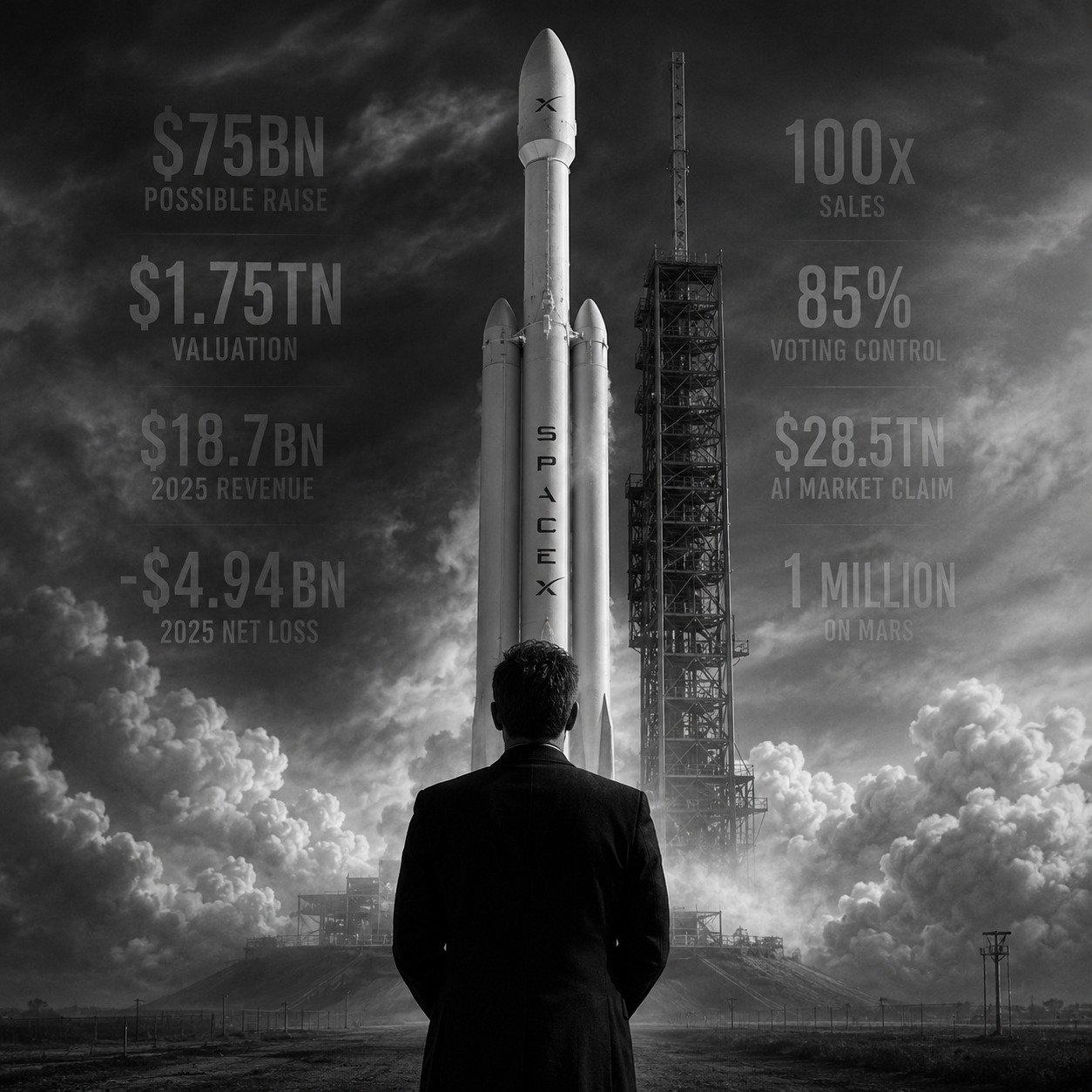
SpaceX is preparing for what may become the largest IPO in history. The company has filed to list on Nasdaq under the ticker SPCX. The numbers already have the scale of empire. A possible raise of around seventy-five billion dollars. A valuation near 1.75 trillion dollars, and perhaps close to 2 trillion. That would put SpaceX among the most valuable companies on earth before ordinary public investors have been able to buy a single share.
The usual question is simple: is it worth it? But with SpaceX the question feels too small. A company with 18.7 billion dollars in revenue in 2025, and a loss of nearly five billion dollars in the same year, is being brought to the market at roughly one hundred times sales. In the first quarter of 2026 alone, Bloomberg reports a net loss of 4.28 billion dollars on revenue of 4.69 billion dollars.
These are not the numbers of a quiet industrial machine. They are not the numbers of a business that has settled into profit and routine. They are the numbers of a company burning vast amounts of capital and asking investors to believe that the burn is not waste, but destiny.
That is why I would call the valuation mystical. Not merely expensive. Not merely optimistic. Mystical. At this level the market is not only pricing rockets, satellites, launch contracts, internet subscriptions, data centres, or military demand. It is pricing belief. It is saying that the future can be gathered into one man. One founder. One will. One story large enough to hold space, artificial intelligence, communications, defence, infrastructure, and Mars.
To be fair, SpaceX is not an empty fantasy. This is not a meme company with no business under it. Starlink is real. It has become the company’s most important business. The FT reports that SpaceX’s connectivity segment, driven by Starlink, generated 11.4 billion dollars of revenue in 2025 and 4.4 billion dollars of operating income. Bloomberg reports that Starlink subscribers rose from 2.3 million in 2023, to 4.4 million in 2024, to 8.9 million in 2025. That is serious growth. SpaceX also dominates much of the launch market and remains a crucial provider for NASA and the Pentagon. The machines exist. The revenue exists. The state contracts exist. The satellites are in the sky.
But that is what makes the valuation more interesting, not less. The mystical part is not that investors believe in nothing. It is that they take something real and stretch it beyond the ordinary grammar of finance. A strong satellite internet business becomes a planetary communications grid. A rocket company becomes the future of logistics. AI losses become proof of ambition. Capital spending becomes pilgrimage. Mars becomes not a dream, but a milestone in a compensation plan.
The ambition in the filing is almost theological. Bloomberg reports that Musk’s goals include a human settlement on Mars with at least one million inhabitants. One million people. Not customers. Not users. Not subscribers. People. A civilisation. Once that enters the investment story, normal valuation has already been left behind. We are no longer asking what SpaceX earns. We are asking what Elon Musk has been chosen to found.
The same is true of artificial intelligence. SpaceX says it is targeting what it calls the largest total addressable market in history: 28.5 trillion dollars, most of it from AI. The FT reports that the company’s AI unit lost 6.4 billion dollars last year on 3.2 billion dollars of revenue, and required 12.7 billion dollars in capital spending. Bloomberg says more than half of SpaceX’s 20.74 billion dollars in capital spending last year was tied to AI. This is not a side project. It is now part of the central story. SpaceX is no longer saying only: we launch rockets and sell satellite internet. It is saying: we may build the infrastructure on which the next age of artificial intelligence depends, even in orbit.
But the gap between the present business and the promised future is immense. The company speaks of data centres in space, AI compute capacity on solar-powered satellites, lunar economies, human augmentation systems, and the transport of humans and cargo to the Moon and Mars. Its own filing warns that these initiatives involve significant technical complexity and may never achieve commercial viability. That sentence matters. It is the small sober sentence inside the cathedral. It says the prophecy may fail.
Then there is control. Musk’s special shares give him about 85 per cent of the voting power at SpaceX. Bloomberg says investors who buy into the IPO will have to accept that they cannot remove him if things go wrong. This is not a small governance detail. It is the structure of the whole thing. Public investors are being asked to supply capital and surrender control. They are not only buying a company. They are buying into a sovereign founder model: one man, one will, one vision, protected from ordinary shareholder discipline.
This is where the politics of the IPO begins. SpaceX is not just another technology listing. It sits where state power, military capacity, communications infrastructure, artificial intelligence, and outer space meet. Its rockets serve governments. Its satellites carry internet access. Its AI plans require staggering amounts of energy and capital. Its Mars plans imagine a future society. And yet the governing idea is not public deliberation. It is private command.
That is why this valuation tells us something about the age we live in. Capital has grown tired of ordinary options. It looks around and sees slow growth, weak institutions, crowded software markets, unstable geopolitics, expensive infrastructure, and an AI boom that demands more money than almost anyone can provide. So it searches for an exit. Not just a financial exit. An existential one. SpaceX offers that exit in symbolic form. Leave the grid. Leave the planet. Leave the state. Leave the old limits behind.
The danger is that we mistake scale for inevitability. A rocket is dramatic. A satellite constellation is dramatic. A Mars city is dramatic. A 1.8 trillion dollar valuation is dramatic. But drama is not logic. A company can be technically brilliant and still be overvalued. A founder can be historically important and still be dangerous to enthrone. A business can matter deeply and still not justify the faith being placed in it.
The mystical valuation of SpaceX is therefore not only a story about Elon Musk. It is a story about investors, institutions, and the age that made this offering possible. It is about a society that has lost confidence in collective capacity and now looks for salvation in founders. Instead of asking what states should build, what publics should own, or what infrastructures should be governed democratically, the market offers another answer: give the future to the man with the rockets.
That is the real meaning of SPCX. It is not just a ticker. It is a creed. It says the future will be privately built, privately governed, and publicly bought after the fact. It says losses can be forgiven if the dream is large enough. It says control can be surrendered if the founder appears exceptional enough. It says a company can be valued not by what it is, but by the civilisation it claims it will one day create.
At nearly one hundred times sales, the market is no longer pricing a company.
It is pricing a prophecy.