Below the Level of Shelter
Below the Level of Shelter
Below the Level of Shelter
In One Day, Everyone Will Have Always Been Against This, Omar El Akkad writes about the moral injury of watching a people placed outside the circle of ordinary human concern. The sentence that stays with me is not only about death. It is about life under that judgment. To be treated as less than human is not only to be killed, counted badly, defended away, or spoken of as a problem. It is to be made to live in conditions where the basic supports of human life are withdrawn and then to be asked, somehow, to continue.
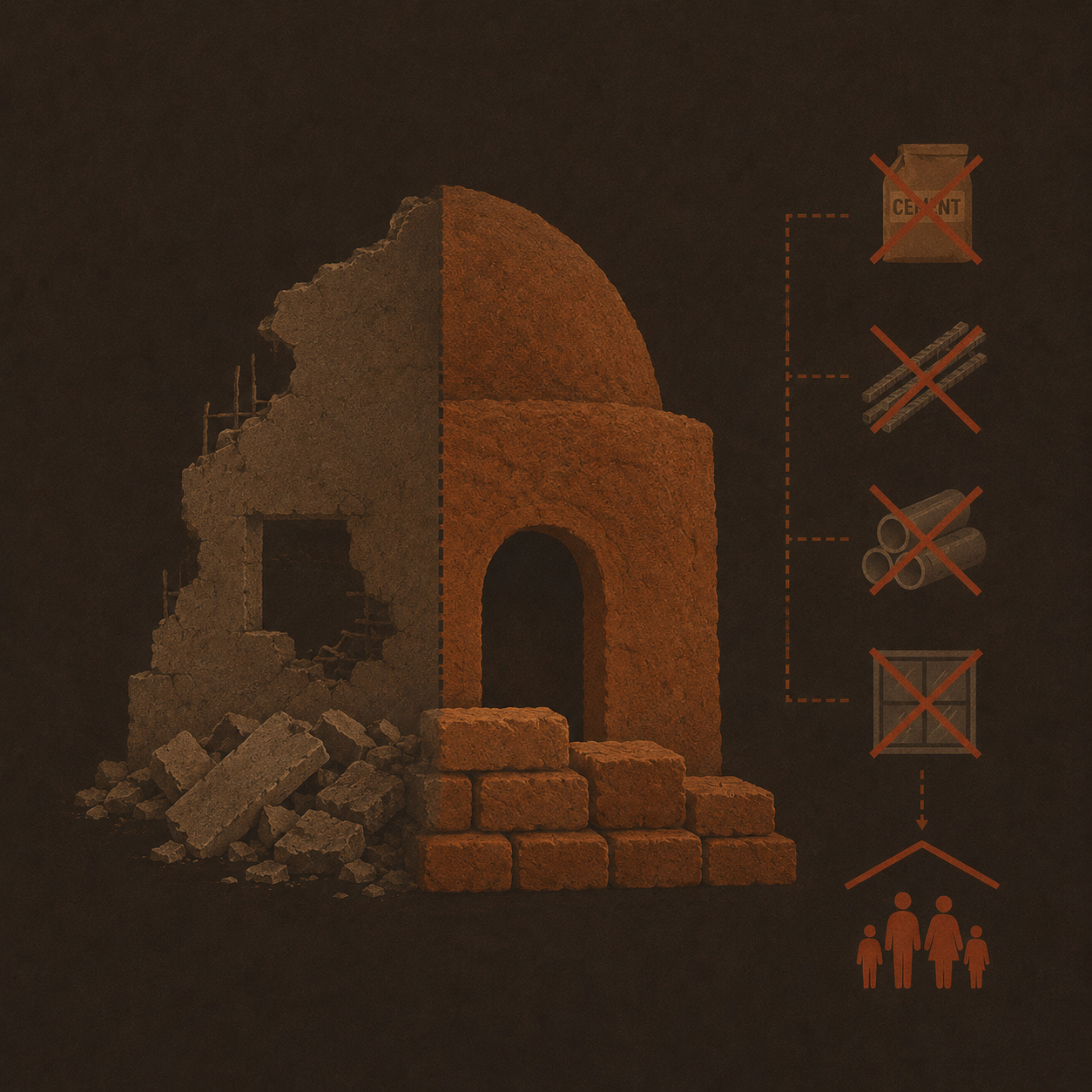
That condition can sound abstract until it enters the built world. A person needs a roof, a wall, a floor, a place to keep food, a room where heat does not punish the body all day. These are not luxuries. They are the ordinary materials through which human life becomes possible. When those materials are blocked, shelter becomes a political fact. Cement, steel, glass, pipes, tarpaulin, rubble, clay: each object begins to show where authority sits and where helplessness is produced.
An article in the Financial Times, titled “Gazans turn to clay and rubble to build new homes,” notes that some Palestinians in Gaza are trying to build shelter from mud bricks, salvaged concrete, ash, glass, and rusted steel because ordinary construction materials remain blocked. This is the detail that struck me. Not only that people improvise. Improvisation can be too easily admired from a distance. It can turn deprivation into a story about ingenuity and make the arrangement that produced the deprivation disappear. The harder fact is that people have been pushed below the level of infrastructure and then forced to search for the minimum conditions of life in whatever remains.
Jaafar Atallah’s clay hut matters because it is both an act of care and a record of constraint. He builds from earth because earth remains available. He draws on a family craft, the making of bread ovens, and turns it into shelter. There is dignity in that, but the dignity does not cancel the violence of the condition. A man should not have to find political freedom at the level of mud. A family should not have to discover which part of the land has not yet been converted into an instrument of permission.
The same is true of the girls making bricks from the rubble of their bombed house. “A solution that comes from the problem itself” is a devastating sentence. It means the destroyed home returns as raw material. It means the evidence of loss must be crushed, mixed, tested, and shaped into the next attempt at protection. The wall that failed to shelter the family becomes a brick for some smaller partition. Destruction becomes inventory.
This is where the article meets El Akkad’s larger fracture. The question is not only whether the world sees Palestinians die. It is whether the world sees the life they are being made to live. A tent without sanitation is not just temporary shelter. A banned bag of cement is not just a security measure. A clay brick is not just a local workaround. These are the units of an imposed existence.
To be treated as human is to have one’s need for shelter understood without argument.
To be treated as less than human is to have to prove that need through mud, rubble, and survival.
Source note:
Book: One Day, Everyone Will Have Always Been Against This — Omar El Akkad
Article: “Gazans turn to clay and rubble to build new homes” — Heba Saleh and Malaika Kanaaneh Tapper, Financial Times