Two Republics, Part Two: Celebration
Two Republics, Part Two: Celebration
Two Republics, Part Two: Celebration
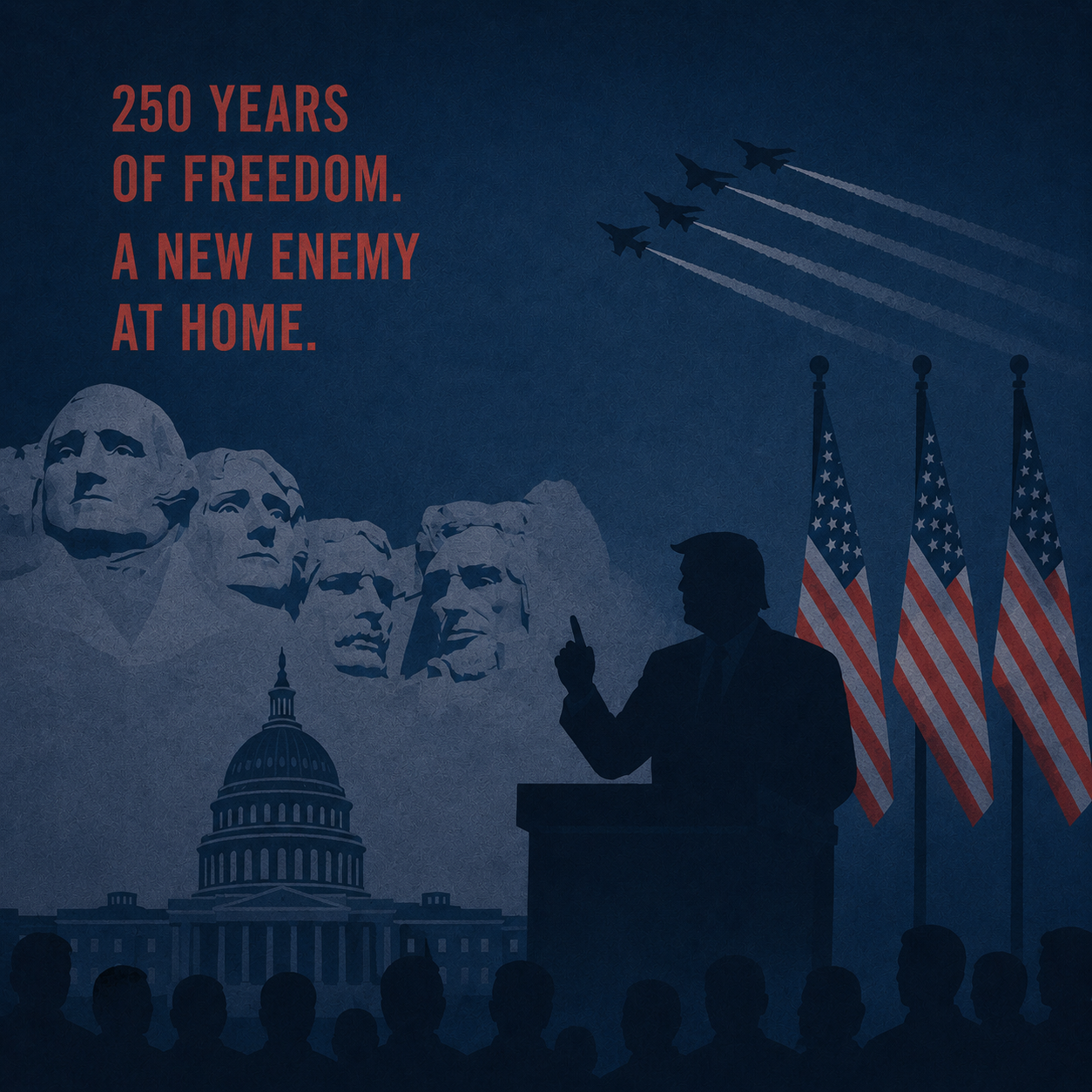
The United States is celebrating 250 years since the Declaration of Independence. There are speeches, military flyovers, fireworks, and repeated appeals to the country’s exceptional history. National anniversaries are moments when states tell stories about themselves. They choose which parts of the past deserve to be remembered and which language should carry the future.
This year another language appeared beside that story. Speaking at Mount Rushmore, President Donald Trump warned of a “resurgence of the communist menace in our land”. He placed that danger alongside the great threats that had confronted the United States through its history and argued that it now existed inside the country itself. The speech was delivered beneath the carved faces of Washington, Jefferson, Lincoln and Roosevelt, turning one of America’s best-known national monuments into a backdrop for an election message.
What interests me is not whether the accusation is true. Political leaders have always described opponents as dangerous. What interests me is the vocabulary itself. Certain words carry institutional memories. They have histories attached to them. “Communist menace” is one of those phrases.
For many Americans, it recalls the years after the Second World War when suspicion became a political instrument. Loyalty investigations spread through government departments, universities, trade unions, newspapers and the entertainment industry. Careers ended not because crimes had been proven but because association itself became suspect. McCarthyism eventually entered the language as a warning about what fear can do to democratic institutions.
The language survives because it performs a useful political function. It shifts disagreement into disloyalty. It asks citizens to see opponents not simply as people with different ideas but as people whose presence threatens the republic itself. Once politics is framed that way, compromise begins to look like surrender and elections begin to resemble battles for national survival.
That shift changes the room available for ordinary political argument. A demand for rent control, labour protection, public health care, debt relief, or higher taxes on wealth can be debated as policy. It can be accepted, rejected, amended, costed, and tested against evidence. But when the demand is placed under the sign of an internal menace, it leaves the ordinary field of disagreement. The argument no longer concerns who pays, who benefits, or what the state should provide. It becomes a question of loyalty.
Every republic creates stories about itself. Iran tells one story through funeral processions, religious symbolism and revolutionary continuity. The United States tells another through independence celebrations, founding documents and constitutional memory. They are profoundly different political systems with different histories and institutions. But both understand that political power depends not only on armies, laws or elections. It also depends on language. The words chosen by those who govern shape the boundaries of belonging.
Perhaps that is what stayed with me this week. One republic buried its supreme leader. Another celebrated its founding. Both reached for public ceremony. Both used it to reinforce the legitimacy of the state. And both reminded me that before institutions change, language often changes first.