Two Republics, Part One: Mourning
Two Republics, Part One: Mourning
Two Republics, Part One: Mourning
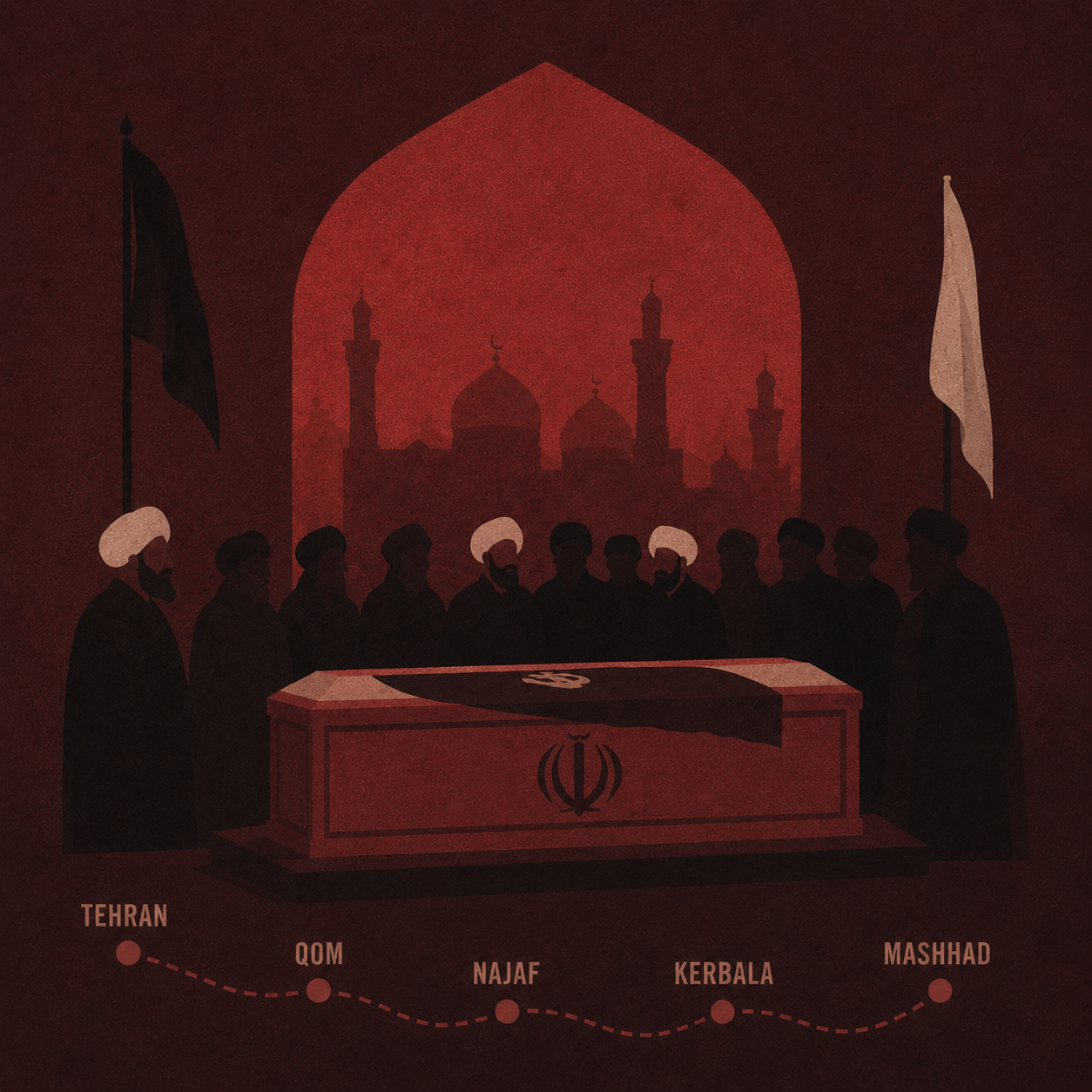
Iran is mourning, but the mourning is not only private. It has been organised by the state. The body of Ayatollah Ali Khamenei lies in state in Tehran while clerics, officials, foreign dignitaries, generals, and supporters pass before the coffin. The funeral has become a week-long movement through the geography of the Islamic Republic and Shi'ite authority: Tehran, Qom, Najaf, Kerbala, and Mashhad. The route matters because it turns death into continuity. It tells the public that the system has suffered a devastating blow, but that the system itself remains.
States often reveal themselves most clearly in moments of uncertainty. They arrange bodies, flags, streets, police, transport, speeches, and crowds. They make grief visible and disciplined. They give people a public script for loss, and they give the state a public script for survival. The funeral does not only honour a dead leader. It also reassures citizens, allies, and rivals that authority has not collapsed with the man who embodied it for nearly four decades.
The detail that stayed with me was not only the coffin. It was the absence beside it. Reuters reports that Mojtaba Khamenei, the new Supreme Leader, has not appeared in any new public image since being wounded in the strike that killed his father. That absence quietly sits inside every image of the funeral. The state displays permanence, but one of the central figures of that permanence remains unseen. The funeral says order. The missing image leaves room for uncertainty.
Power often works this way after a shock. It does not only issue commands. It stages continuity. It fills public space with symbols so that private doubt has less room to gather. The coffin becomes a political object. The procession becomes an argument. The crowd becomes evidence. The journey through Iran's religious centres ties the death of one leader to the longer history of the Islamic Republic and to the institutions that claim to outlive every individual who occupies them.
The scale of the ceremony also says something about the scale of the problem. A state does not mobilise this much ritual when authority feels ordinary. It does so when authority must be demonstrated. Roads are closed. Security is expanded. Transport is organised. Religious institutions, government agencies, and state media work together to produce a single public event. Mourning becomes administration.
That does not tell us whether the state is strong or weak. It tells us that political power depends on being seen. Institutions require ceremonies that make authority visible. Governments require moments when continuity can be performed as much as declared. In times of stability those performances fade into the background. In times of crisis they become unavoidable.
Perhaps that is what this funeral really reveals. It is not simply the end of one ruler's life. It is a moment when the Islamic Republic must persuade millions of people that its institutions still stand above the uncertainty created by war, succession, sanctions, and internal division. The coffin is real. The grief is real. But the funeral is also political work. It is an attempt to convert loss into legitimacy and uncertainty into continuity.
Source Note
Reuters, Khamenei lies in state in Tehran as Iran begins week of funeral ceremonies.