What Did the Iraq War Achieve?
What Did the Iraq War Achieve?
What Did the Iraq War Achieve?
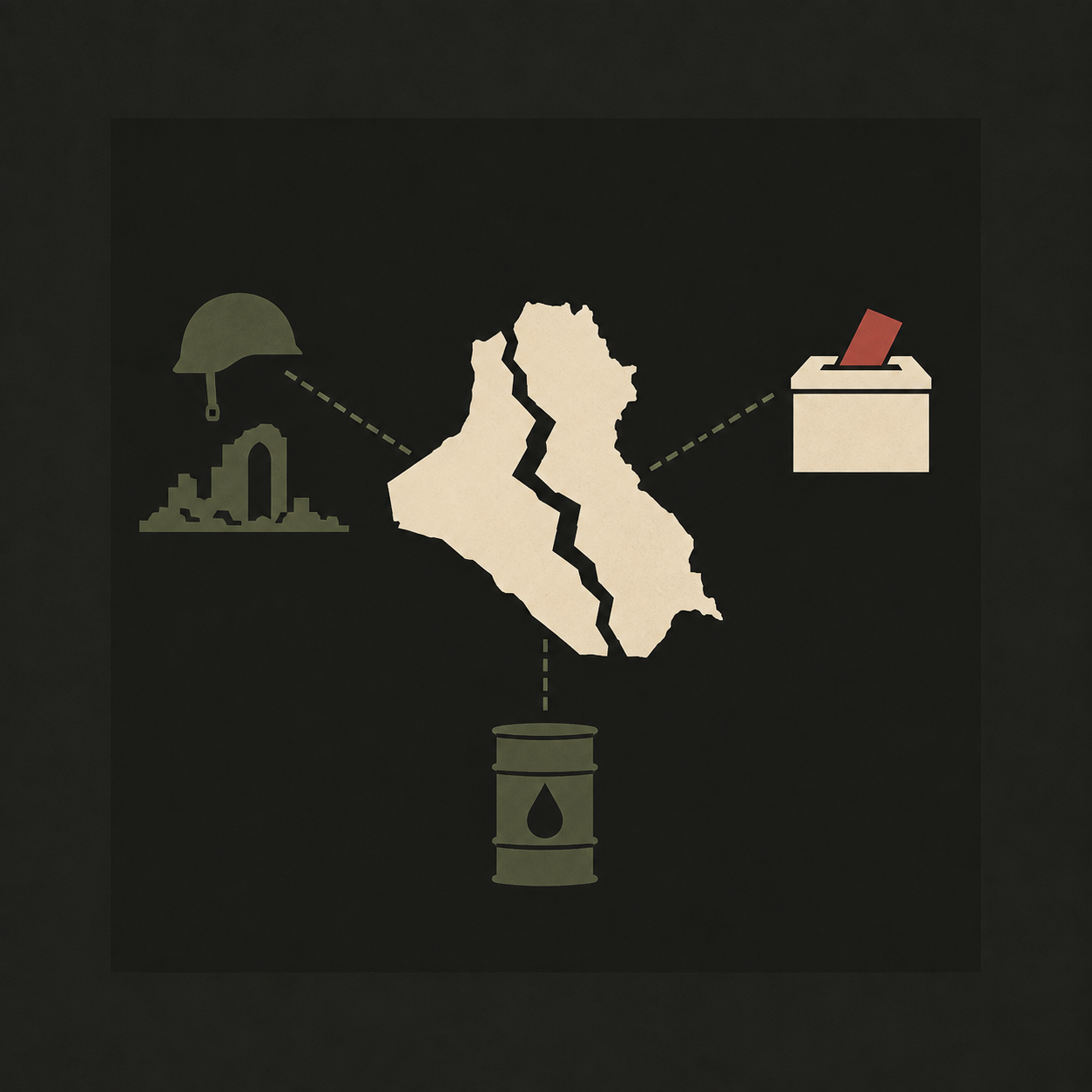
Twenty-three years after the United States invaded Iraq, American forces have left the country. The withdrawal completed at the end of September closes the latest stage of an American military involvement that was not continuous: the main force withdrew in 2011 and troops returned in 2014 after Islamic State seized large parts of Iraq. That history matters because the war cannot be judged by a single result. Saddam Hussein was removed, Iraq eventually developed competitive elections and American forces later helped Iraqi troops destroy Islamic State’s territorial caliphate. Those were real outcomes. The harder question is what they amount to when set against the case for invading, the choices made after Saddam fell and the consequences that followed.
The case for war rested heavily on a threat that did not exist in the form presented to the public. The 2002 congressional authorization said Iraq continued to possess and develop chemical and biological weapons capabilities and was seeking nuclear weapons. It also cited Saddam’s repression, Iraq’s breaches of United Nations resolutions and terrorism, so weapons of mass destruction were not the only stated reason for war. But they were central to the argument that Iraq posed a growing danger which could no longer safely be contained.
The weapons were not found. Britain’s Iraq Inquiry later concluded that public statements about the threat conveyed greater certainty than the intelligence justified. It also found something just as important. Diplomatic options had not been exhausted when Britain joined the invasion in March 2003. UN inspectors were still operating in Iraq and believed they were making progress. Military action, the inquiry concluded, was not yet a last resort.
Saddam’s government nevertheless collapsed within weeks. Winning the war proved much easier than deciding what should replace the state that had been destroyed.
The Coalition Provisional Authority began de-Ba’athification within weeks of taking control. Senior Ba’ath Party members were removed from public employment and officials across ministries and other state bodies were screened. The authority then dissolved the Iraqi armed forces and a range of security institutions. There were reasons for refusing to preserve the machinery through which Saddam had ruled. But these decisions did more than remove senior figures from the old regime. They also stripped away parts of the state through which Iraq had been administered and left large numbers of trained former soldiers and officials outside the new order.
It would be too simple to draw a straight line from those decisions to everything that followed. Iraq had been damaged by dictatorship, war and sanctions long before American troops arrived. Sunni-Shia divisions had their own history. Iraqi political leaders, insurgents, militias, neighbouring governments and jihadist groups all made choices after 2003 that shaped the country. The invasion did not create every force that later tore Iraq apart.
But it changed the conditions in which those forces acted. Regime change brought sectarian political parties to the centre of the new state. The occupation struggled to build institutions that commanded broad support. Sunni rejection of the new order hardened and armed resistance grew. Al-Qaeda in Iraq emerged, sectarian killing spread and Islamic State eventually seized Mosul and large parts of northern and western Iraq in 2014. America did not simply create ISIS. But ISIS developed within a political order profoundly changed by the invasion and the state that followed it.
We cannot know what Iraq would have become had the invasion never happened. Saddam remained a dictator and the Iraqi state was already badly weakened. That counterfactual places a limit on any claim that every death, militia or act of sectarian violence after 2003 can be laid at Washington’s door. The narrower claim is strong enough: the invasion overturned the existing state and decisions made during the occupation helped shape the order in which insurgency, civil conflict and later Islamic State developed.
The human cost is less difficult to establish. Brown University’s Costs of War project estimates that roughly 187,000 to 210,000 Iraqi civilians were killed directly by war violence between 2003 and 2023. Thousands of American service members were also killed. Millions of Iraqis experienced displacement over the years that followed. Those estimates cover direct violent deaths and should not be confused with the much harder question of how many people died indirectly because health care, infrastructure, livelihoods and communities were damaged by war.
Yet Iraq was not simply left in ruins. Elections became part of political life and voters could choose among competing parties in a way that had been impossible under Saddam. When Islamic State threatened the Iraqi state, American forces returned and helped Iraqi troops recover territory and destroy the group’s caliphate. Any serious judgment of the war has to hold these facts alongside the failures rather than remove them because they complicate the argument.
The same is true of Iran. Saddam Hussein’s Iraq had been one of Iran’s main regional enemies. By overthrowing him, the United States removed a state that had fought Iran for eight years and had acted as a major check on Iranian power. The political system that followed brought Shia Islamist parties with longstanding links to Tehran into government, while Iran built influence through political networks and armed groups.
Not everything that happened after 2003 benefited Iran. Islamic State threatened Iranian interests as well as American ones and Iraq remained a sovereign country with its own political struggles. But the broad shift is difficult to dispute. Washington spent years trying to limit Iranian influence in the Middle East and then destroyed one of the strongest states that had constrained it.
This is where the Iraq story moves beyond the question of military victory and failure. It becomes a question about political responsibility.
Tony Blair, who took Britain into the war alongside George W. Bush, now sits on Donald Trump’s founding Executive Board of the Board of Peace and on its Gaza Executive Board. Those bodies have been given roles in governance, reconstruction, investment and political transition in Gaza. Blair therefore again holds a formal position in planning what should follow the destruction of an Arab territory.
His appointment tells us nothing by itself about whether those plans will succeed. But it sits uneasily beside the findings of Britain’s own inquiry into Iraq. That inquiry concluded that the threat had been presented with a certainty the evidence did not support, that peaceful options remained available and that preparations for what would happen after Saddam fell were inadequate.
The point is larger than Blair. Political systems can investigate failure, publish thousands of pages about what went wrong and preserve the record for historians, while the people who made the decisions remain close to the institutions that make the next ones. The consequences do not fall in the same way. For Iraqis, the invasion became part of daily life for a generation. For political leaders in Washington and London, it became part of a record that could be debated, defended, regretted or explained while public life went on.
The Iraq War therefore resists a simple verdict. Saddam fell. Iraqis gained elections. Islamic State’s territorial rule was defeated. But the principal weapons threat used to establish the urgency of invasion proved false, military action began before peaceful options had been exhausted, occupation policies damaged an already weakened state, hundreds of thousands of civilians were killed by direct violence, millions were displaced and Iran gained far more room inside Iraqi politics.
That is what the American departure leaves behind. Not proof that nothing was achieved, and not proof that every later disaster began in March 2003. It leaves a harder record of how powerful states decide to use force, how far the consequences can spread when their premises prove wrong, and how unevenly those consequences are carried.
To support my work and help keep these essays free and ad-free, you can support me on Patreon. Subscribers also receive the source notes and reading lists behind my work.